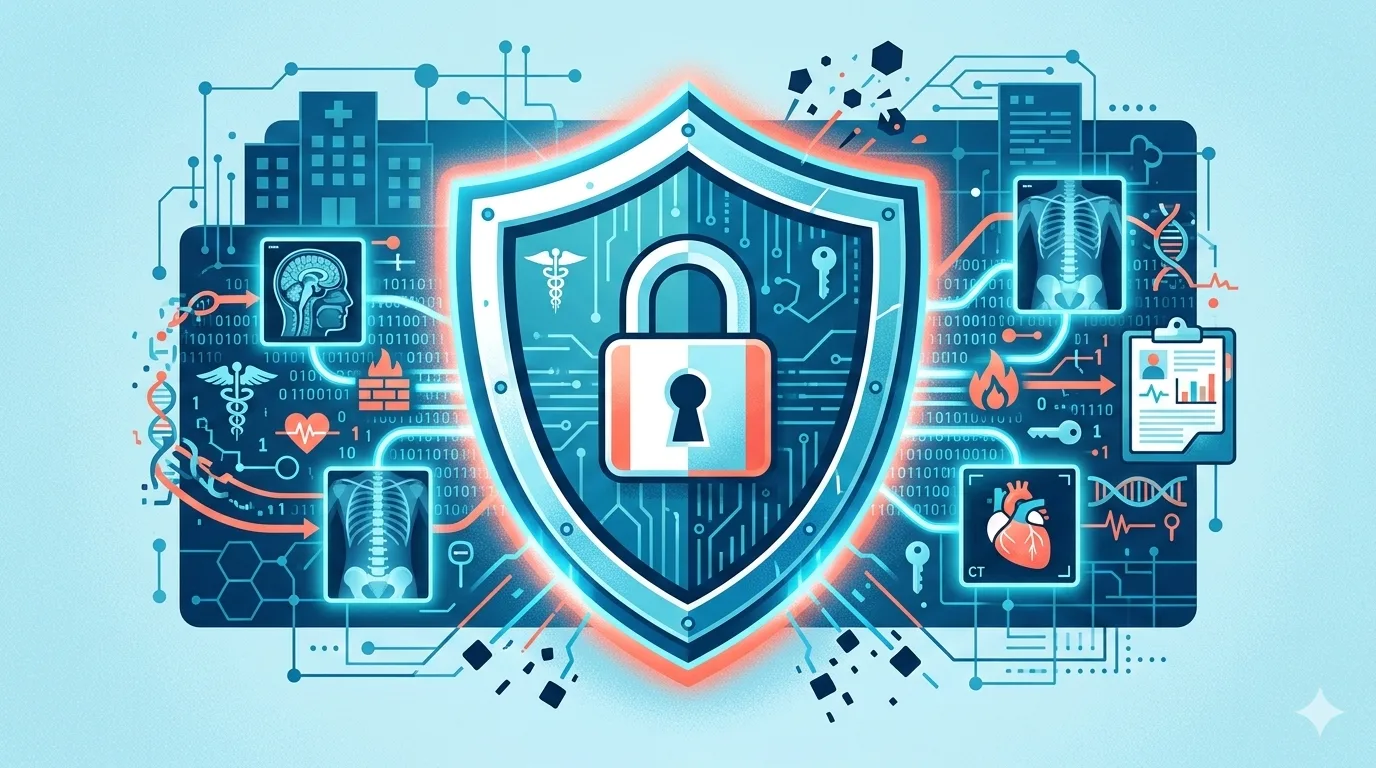
HIPAA, Encryption, and Expiring Links: How Medixshare Keeps Your Scans Safe
A medical scan is not just a file. It is a picture of the inside of your body. Your MRI captures the soft tissue of your brain, your spine, your joints. A CT scan maps your organs in three dimensions. A mammogram records the most intimate details of your anatomy. These images carry your name, your date of birth, your medical record number, and often the clinical notes your radiologist wrote about what they found.
There is no category of personal data more sensitive than this. And yet, every day, millions of patients share their scans by burning them onto CDs that get lost in glove compartments, texting photos of film on a lightbox, or emailing unencrypted files across the open internet. The gap between how sensitive this data is and how casually it gets handled is staggering.
Medixshare, developed by AI Bharata, was built to close that gap. Here is exactly how it works — layer by layer, from the encryption that protects your files to the access controls that put you in charge of who sees them.
HIPAA 101: What It Actually Means for You
You have probably seen the word “HIPAA” on forms at your doctor’s office. Most people sign the acknowledgment and move on without thinking much about it. So let us break it down plainly.
HIPAA — the Health Insurance Portability and Accountability Act — is a federal law that sets the rules for how your health information must be protected. It applies to healthcare providers, insurance companies, and the technology platforms that handle medical data on their behalf. The law requires three things that matter directly to you:
Privacy. Your health information cannot be shared without your consent, except in specific circumstances defined by law. You control who gets to see your records.
Security. Any organization that stores or transmits your health data must implement administrative, physical, and technical safeguards to protect it. This means encryption, access controls, audit logging, and more.
Breach notification. If your data is compromised, the organization must notify you. There are no quiet cover-ups allowed under HIPAA.

When a platform like Medixshare says it is “HIPAA-ready,” that is not marketing language. It means the platform has been designed from the ground up to meet every technical and administrative requirement the law demands. It means your scans are handled with the same rigor that a hospital’s own systems are required to meet.
End-to-End Encryption: Your Scan Is Locked From the Moment It Leaves Your Device
Encryption is the foundation of everything else. Without it, the rest of the security architecture does not matter. So let us be specific about what Medixshare does.
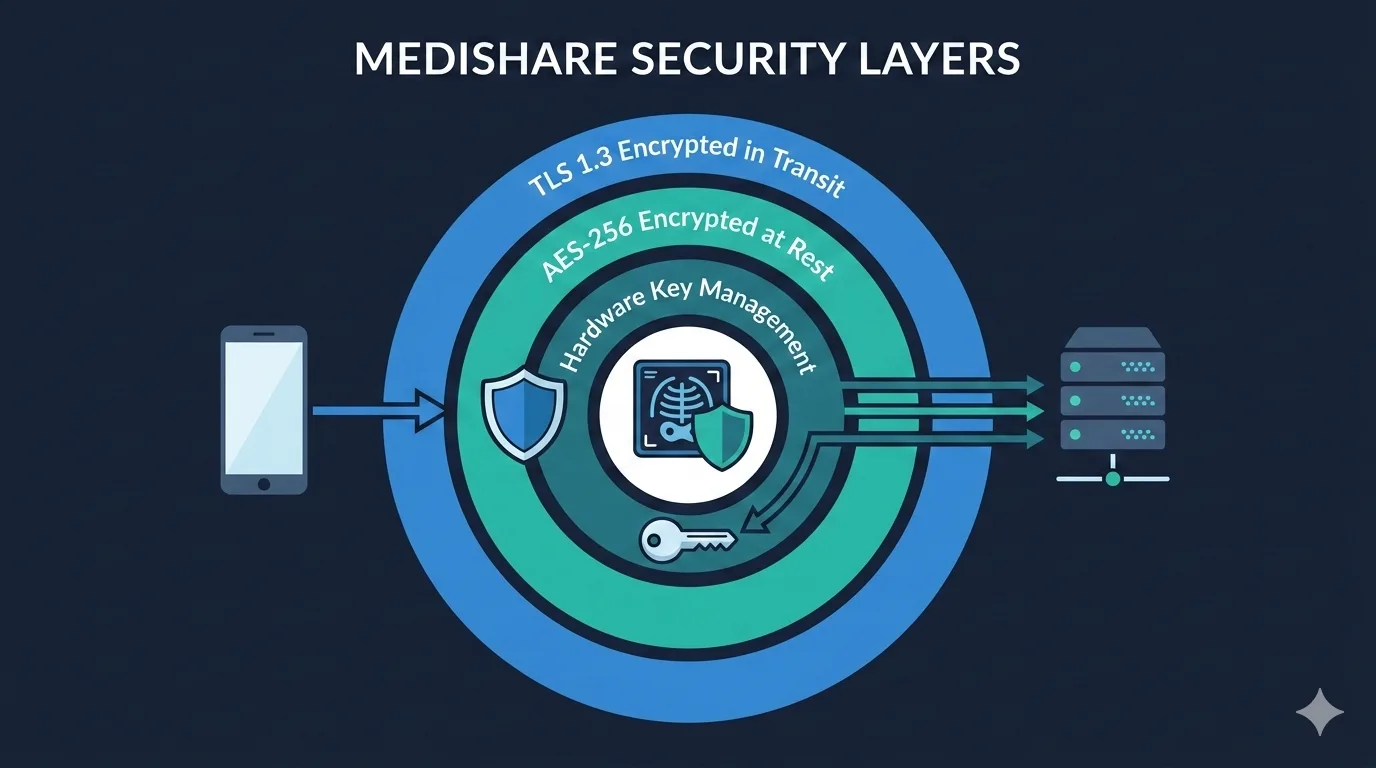
In transit: When you upload a scan to Medixshare, the data is encrypted using TLS 1.3 — the same protocol that protects online banking and government communications. This means that even if someone were to intercept the data while it travels from your device to our servers, they would see nothing but scrambled, unreadable noise.
At rest: Once your scan reaches Medixshare’s servers, it is encrypted again using AES-256, the encryption standard used by intelligence agencies worldwide. Your file is not sitting on a server somewhere in plain form, waiting for someone to stumble across it. It is locked, and only authorized access through the platform can decrypt it.
Key management: Encryption is only as strong as the way the keys are managed. Medixshare uses hardware-backed key management with strict separation of duties. No single engineer, no single system process, can access both the encrypted data and the keys needed to decrypt it. This is not a detail most patients will ever think about, but it is the kind of detail that separates genuine security from security theater.
The result: your scan is protected from the moment it leaves your phone, tablet, or computer until the moment an authorized recipient opens it on their end. There is no window of vulnerability.
Expiring Links: Share Access That Automatically Disappears
This is one of the features patients tell us they appreciate most, because it solves a problem everyone has experienced: you share something, and then you lose control of it forever.
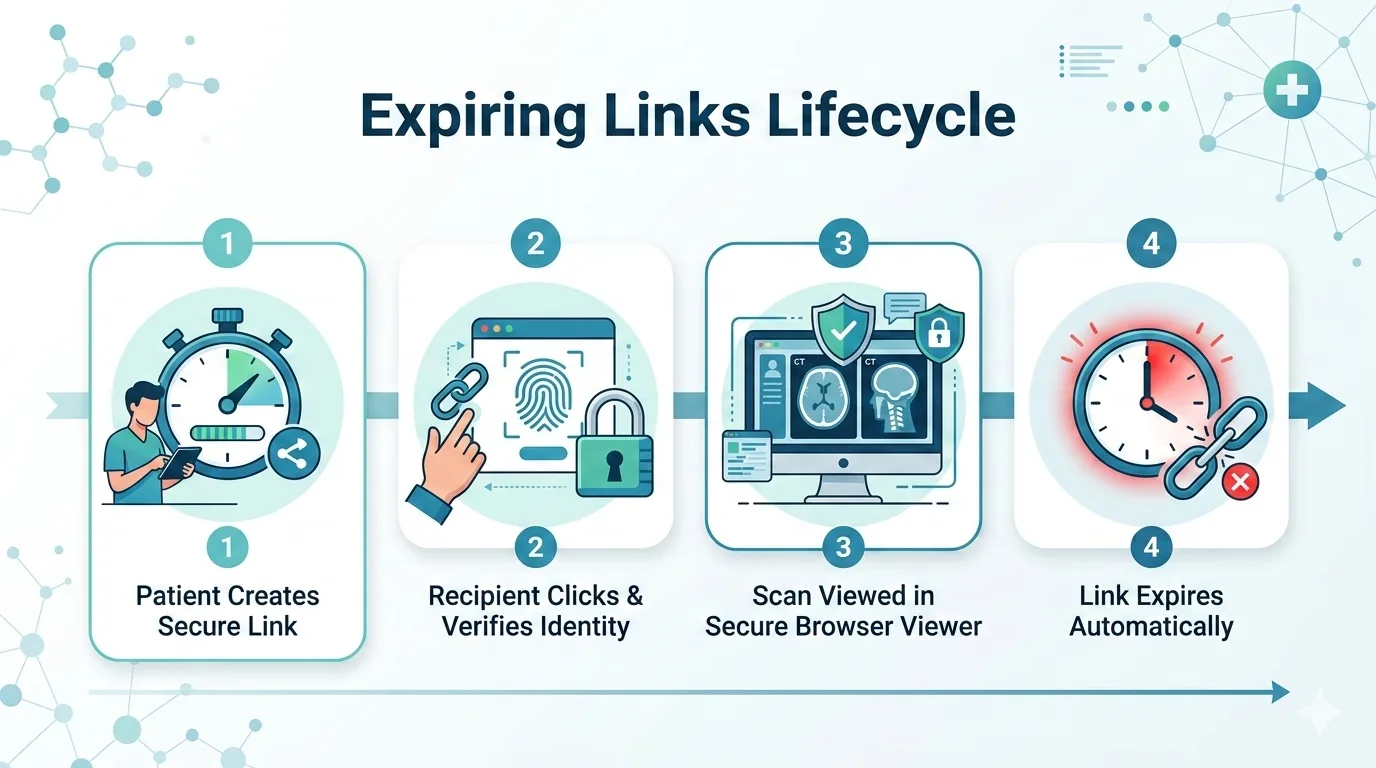
When you share a scan through Medixshare, you generate a secure link. That link has an expiration. You choose the timeframe — one hour, twenty-four hours, seven days, or a custom window. When the time is up, the link stops working. Period. Anyone who clicks it after expiration sees nothing.
This matters more than most people realize. Think about what happens when you email a scan to a doctor’s office. That email sits in their inbox indefinitely. It gets backed up to their email server. It might get forwarded to a colleague, who forwards it to another colleague. Six months later, your scan is sitting in five different inboxes, none of which you control.
Expiring links eliminate this problem entirely. You share access for exactly as long as it is needed, and then access reverts back to you automatically. No follow-up required. No awkward “please delete that” emails. The system handles it.
And here is something that makes Medixshare particularly practical: the recipient does not need a Medixshare account to view the scan. They click the link, verify their identity if you have set that requirement, and view the scan in a secure, browser-based DICOM viewer. When the link expires, the access is gone. It is that simple.
Granular Access Controls: You Decide Who Sees What
Expiring links are one dimension of control. Granular access controls are the other.
When you share a scan through Medixshare, you are not handing over a file. You are granting a specific permission, and you define exactly what that permission includes:
-
View only or download. You can allow a recipient to view your scan in the browser without ever being able to download the file to their own device. This is ideal when you want a second-opinion consultation but do not want copies of your scan floating around.
-
Specific scans, not everything. If you have uploaded multiple studies — say, a knee MRI and a chest X-ray — you can share one without exposing the other. Your orthopedist sees the knee. Your pulmonologist sees the chest. Neither sees anything beyond what is relevant to them.
-
Revoke at any time. Changed your mind? You can revoke access to any shared link instantly, even before it expires. You do not have to wait for the timer to run out. One click, and the access is gone.
-
Require identity verification. For particularly sensitive scans, you can require the recipient to verify their identity — through email confirmation or a one-time passcode — before they can view the link contents. This ensures that even if a link is accidentally forwarded to the wrong person, they cannot open it.
This level of control does not exist in email. It does not exist when you hand someone a CD. It barely exists in most hospital patient portals. Medixshare puts you in the position of deciding exactly who sees your body’s most private images, and for how long.
Audit Trails: Every Access Is Logged
Trust is good. Verification is better.
Every time someone accesses your scan through Medixshare, the event is logged. You can see a complete history:
- Who accessed your scan (or attempted to access it)
- When the access occurred, down to the timestamp
- What they did — whether they viewed the scan, downloaded it (if permitted), or were denied access
- Where the access originated, based on IP address and device information
This audit trail is available to you as the patient. You do not have to ask anyone for it. You do not have to file a request. It is right there in your Medixshare dashboard, giving you a clear, factual record of every interaction with your shared data.
For healthcare organizations, these audit trails also satisfy HIPAA’s requirement for access logging and monitoring. But for you as a patient, the value is simpler: you always know exactly what happened with your scans. No surprises. No uncertainty.
For Hospitals and Practices: Enterprise-Grade Security
Medixshare is built for patients, but it is also built for the healthcare organizations that serve them. If you are a hospital administrator, a practice manager, or a health IT professional evaluating Medixshare for your organization, here is what the enterprise tier includes:
Business Associate Agreement (BAA). Medixshare will execute a BAA with your organization, formally establishing the legal obligations both parties have under HIPAA. This is not optional for any platform handling protected health information on behalf of a covered entity — and we make the process straightforward.
SOC 2 Type II compliance. Medixshare’s infrastructure and processes are audited against the SOC 2 framework, covering security, availability, processing integrity, confidentiality, and privacy. This is the industry standard for demonstrating that a cloud platform has rigorous, independently verified controls in place.
99.9% uptime SLA. When a surgeon needs a patient’s prior imaging at 2 AM before an emergency procedure, the platform must be available. Medixshare’s enterprise tier comes with a 99.9% uptime service-level agreement, backed by redundant infrastructure across multiple availability zones.
On-premise and private cloud deployment. For organizations with regulatory requirements or institutional policies that mandate keeping data within their own infrastructure, Medixshare offers on-premise and private cloud deployment options. Your data never has to leave your own network if that is what your compliance framework requires.
These are not add-ons. They are the baseline for any platform that claims to be serious about healthcare data security.
Why “Just Texting a Photo” of Your Scan Is a Bad Idea
It happens constantly. A patient holds their phone up to a lightbox in the imaging center, snaps a photo of their MRI, and texts it to a family member or even to another doctor. It feels quick and easy. It is also a genuinely bad idea, for several reasons:
No encryption. Standard SMS messages are not encrypted end-to-end. The image travels through your carrier’s network, your recipient’s carrier’s network, and potentially multiple intermediary servers — all in plain form. Anyone with access to those systems can see it.
No access control. Once you text an image, you have zero control over what happens next. It can be forwarded, screenshot, saved to someone’s camera roll, uploaded to cloud photo storage, or backed up to a service you have never heard of. You cannot revoke it. You cannot expire it. It is gone.
Diagnostic quality is lost. A photo of a scan on a lightbox is not a diagnostic-quality image. It loses resolution, contrast, and the ability to window and level — the tools radiologists use to examine different tissue densities. If you are sharing a scan for a medical opinion, the recipient needs the actual DICOM file, not a photograph of it.
No audit trail. There is no record of who saw the image, when, or what they did with it. If a breach occurs, you will never know.
No HIPAA protection. Text messages are not covered by the same safeguards that apply to a HIPAA-compliant platform. If something goes wrong, you have no regulatory framework protecting you.
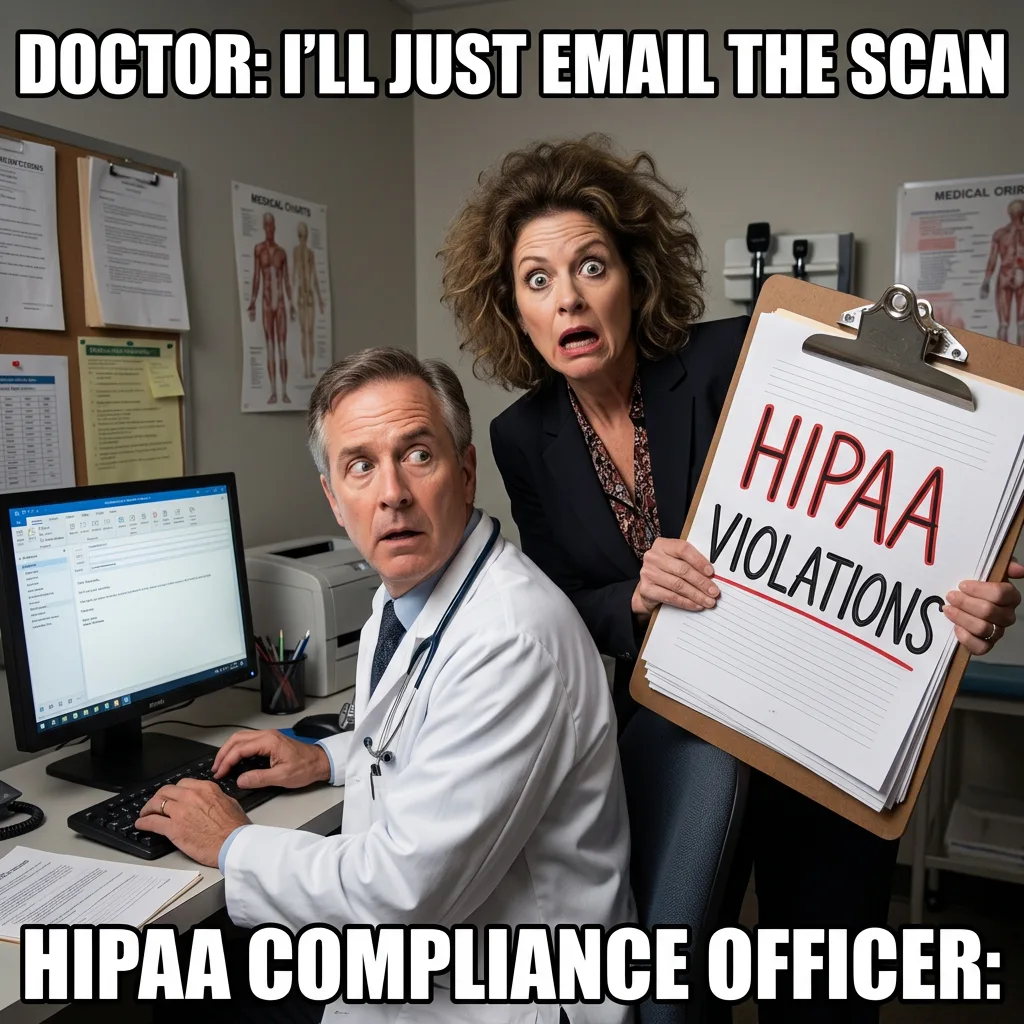
Medixshare solves every one of these problems. The scan is shared in its original DICOM format, at full diagnostic quality, through an encrypted channel, with access controls and audit logging, and with an expiration that you set. It takes about the same amount of time as texting a photo. The difference in security is enormous.
Share Your Scans Safely
Your medical images deserve the same level of protection as your financial data, your legal documents, and your most private communications — arguably more, because they are irreplaceable records of your health.
Medixshare was designed to give you that protection without making you jump through hoops. No CDs to burn. No accounts for your recipients to create. No unencrypted emails. Just a secure link, under your control, with encryption, expiration, access controls, and a full audit trail working quietly in the background.
Watch: How Medixshare’s security layers protect your scans
Ready to share your scans the safe way? Get started with Medixshare — it is free for patients, and it takes less than a minute to share your first scan securely.
For healthcare organizations interested in enterprise deployment, contact our team to discuss BAA execution, SOC 2 documentation, and deployment options tailored to your infrastructure.