Patient Portals vs. Instant Sharing: The Real Cost of Scan Access Friction
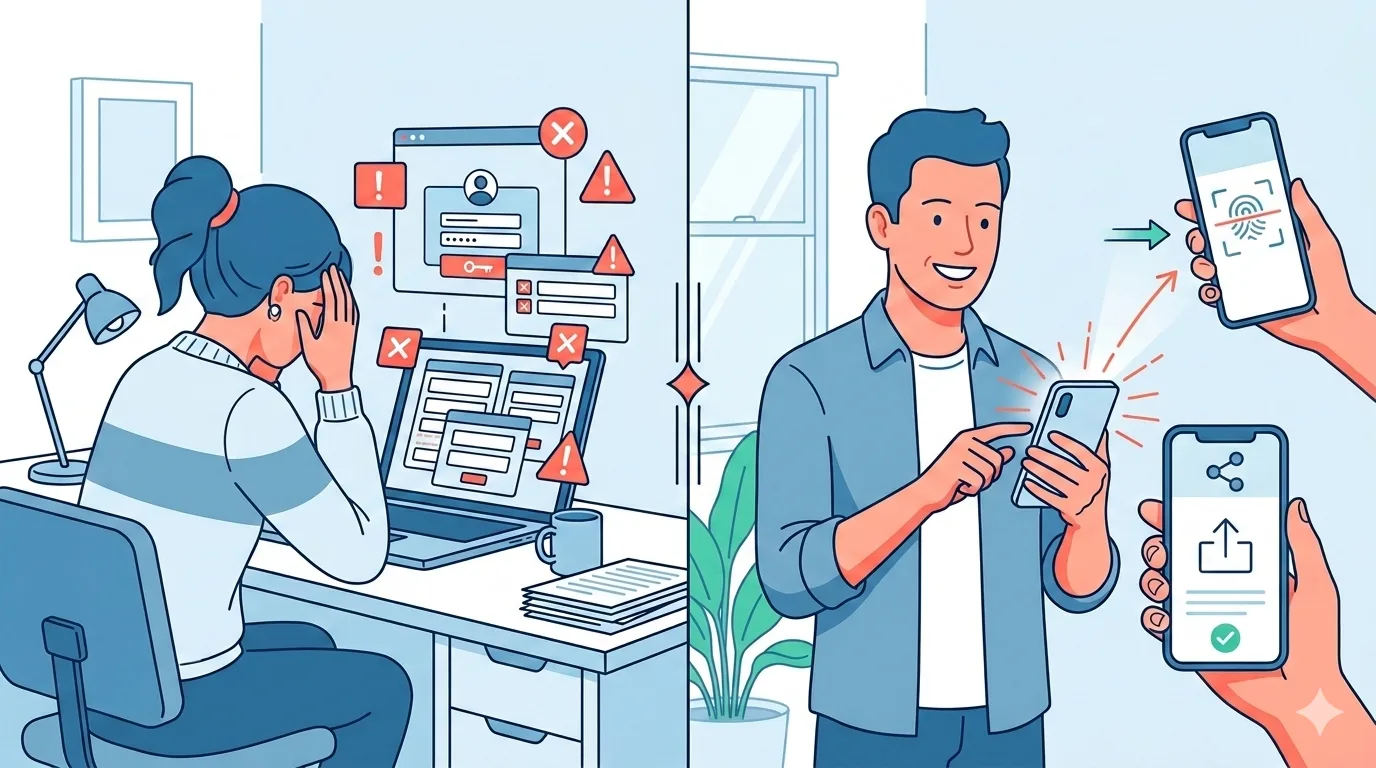
You had an MRI on Tuesday. By Wednesday afternoon, your doctor mentions the results are “available in the portal.” Simple enough. You pull out your phone and try to log in.

What’s your username again? You try your email. Wrong. You try the username you set up two years ago during that ER visit. Also wrong. You hit “Forgot Password,” wait for an email that takes four minutes to arrive, set a new password that requires twelve characters with a special symbol and a number but not the same one you used last time, and finally get in.
You’re staring at a dashboard full of lab results, appointment summaries, and billing notices. Where are the images? You tap “Test Results.” There’s the radiology report — a wall of text. But the actual scan? The images your specialist needs to see before your consultation on Friday?
They’re either not there, or they’re a single thumbnail that looks like it was photographed through a screen door.
This is the patient portal experience. And if it sounds familiar, that’s because it is — for tens of millions of people.
The Portal Promise vs. Portal Reality
Patient portals were supposed to be the answer to medical record access. The pitch was compelling: one login, all your health data, available anytime. Hospitals invested millions. Federal regulations pushed adoption. By 2026, nearly every health system in the country has one.
On paper, it’s a solved problem. In practice, it’s a maze.
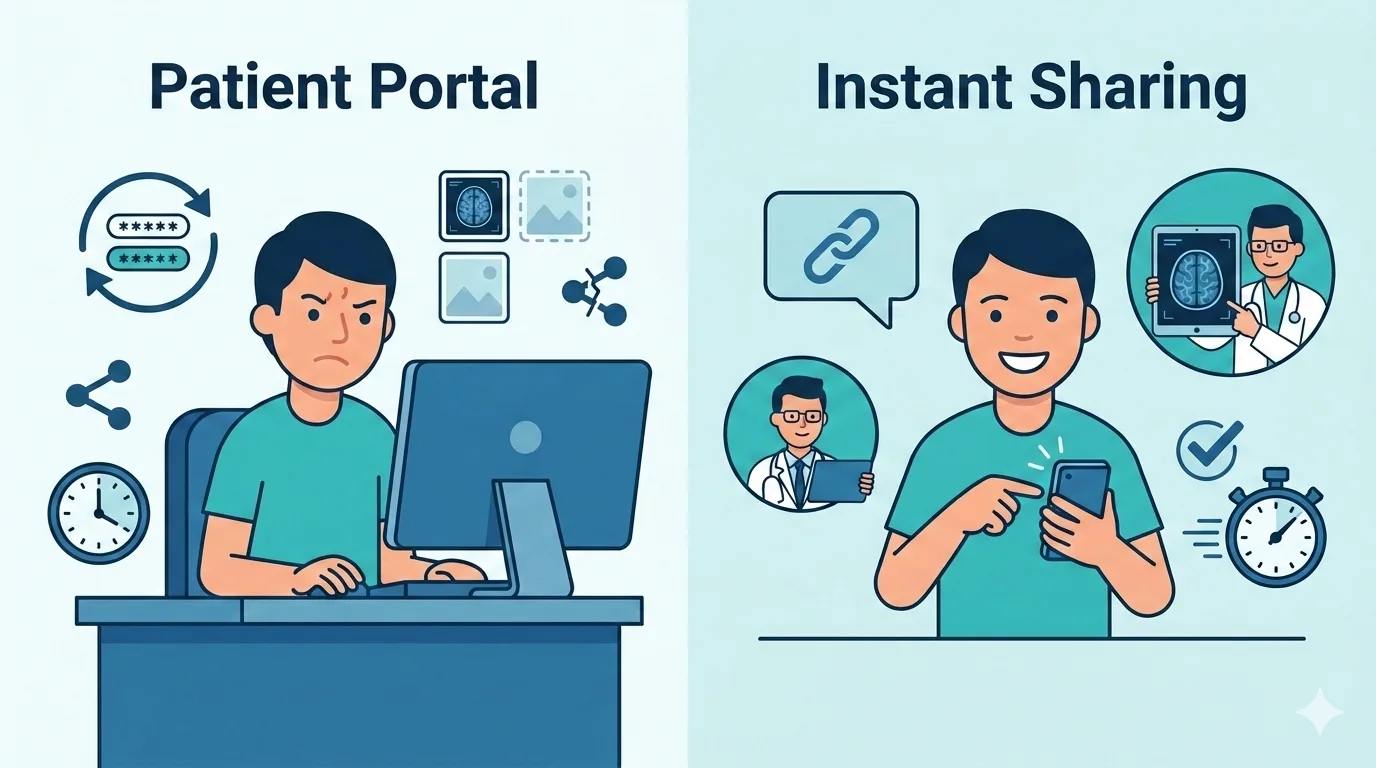
The login barrier is real. Studies consistently show that a significant percentage of patients who have portal accounts rarely or never use them. The reasons are predictable — forgotten credentials, confusing interfaces, and the simple fact that most people interact with their health system a few times a year, not every day. You don’t build muscle memory for a site you visit twice annually.
Imaging is the portal’s weakest link. Even patients who successfully log in discover that their scan images are often missing entirely. Many portals display the radiology report text but not the DICOM images themselves. When images do appear, they’re frequently compressed thumbnails — useful for confirming a scan happened, useless for clinical review.
Sharing is a dead end. Here’s the part that really stings. Even if your portal has your full scan, try sending it to another doctor. Most portals offer no mechanism for sharing imaging with an outside provider. You can print the report. You can screenshot the thumbnail. But you cannot get the actual diagnostic-quality images from your portal to the specialist across town who needs them before Friday.
The portal was built to show you your data. It was never built to help you move it.
The Hidden Costs of Friction
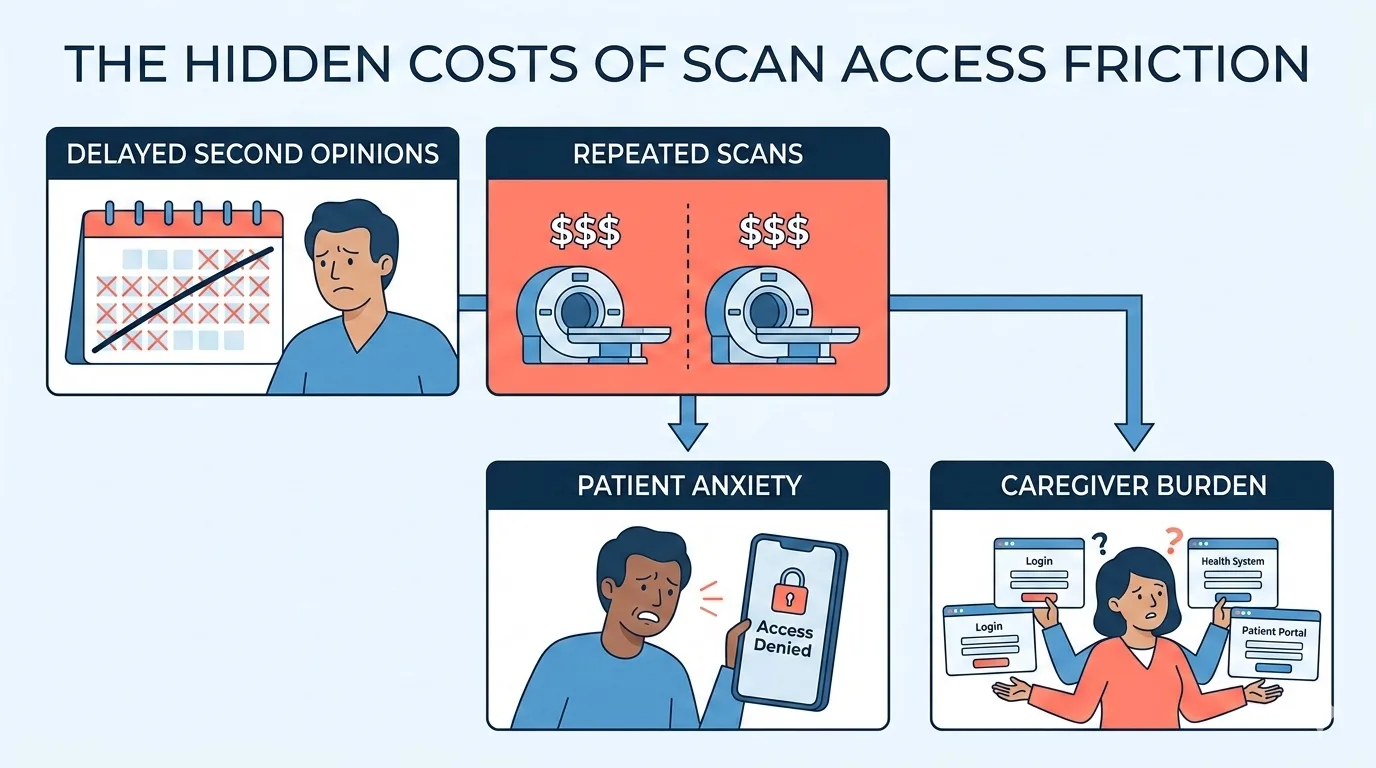
Portal frustration isn’t just an inconvenience. It has measurable consequences for patients, doctors, and the healthcare system.
Delayed second opinions. A patient with a suspicious finding on a CT scan wants a second radiologist to review it. The portal won’t share the images. The hospital’s medical records department takes three to five business days to process an image release. The specialist has an opening this week, but without the images, the consultation gets pushed to next month. That’s weeks of anxiety over what might be a time-sensitive diagnosis.
Repeated scans. When sharing is hard enough, the path of least resistance becomes ordering a new scan. The specialist can’t get the outside images in time, so they order their own MRI. The patient absorbs another copay, another dose of radiation (for CT), and another hour inside a machine — all because moving an existing file from one place to another was too complicated.
Patient anxiety spirals. There’s a particular kind of stress that comes from knowing your medical data exists somewhere but being unable to reach it. You’re told the results are “in the portal,” but you can’t log in. Or you can log in but can’t understand what you’re looking at. Or you can see the report but not the images your doctor referenced on the phone. The information asymmetry is maddening. It makes people feel powerless about their own health.
Caregiver burden. It gets worse when you’re managing scans for someone else — an aging parent, a child, a spouse. Now you’re navigating proxy access, separate portal accounts, authorization forms. The system assumes every patient is a tech-literate adult managing their own care. Many aren’t.
These aren’t edge cases. This is the daily reality of scan access in most health systems.
What “Instant Sharing” Actually Means
The word “instant” gets thrown around loosely in healthcare marketing. So let’s be specific about what Medixshare does and how it works, in plain terms.
Step 1: The scan gets uploaded. After your imaging study — whether it’s an X-ray, CT, MRI, ultrasound, or mammogram — the DICOM files are uploaded to Medixshare. This can be done by the imaging facility, by your doctor’s office, or by you directly if you have the files.
Step 2: You get a shareable link. Medixshare generates a secure link to your scan. That link can be sent via SMS, WhatsApp, or email — whatever works for you. No app to download. No account to create. No software to install.
Step 3: Anyone you share it with can view the full scan. Your specialist, your primary care doctor, your surgeon, the radiologist reviewing it for a second opinion — they tap the link and the scan opens in their browser. Full resolution. Every slice. Zoom, scroll, adjust window and level. Diagnostic-quality viewing on any device.
Step 4: You stay in control. Links can be set to expire. Access can be revoked. You decide who sees your scans and for how long. Your images, your rules.
That’s it. No password resets. No proxy access forms. No calling medical records. No burning a CD and driving it across town. The total time from “I need to share this scan” to “my doctor is looking at it” is measured in seconds.
And Medixshare is free. Not “free trial.” Not “free for the first scan.” Free forever. Because access to your own medical images shouldn’t have a price tag.
Feature Comparison: Patient Portal vs. Medixshare
| Feature | Typical Patient Portal | Medixshare |
|---|---|---|
| Account required | Yes — username, password, registration | No account needed |
| Login required to view | Yes, every time | No — open via link in any browser |
| Full DICOM images available | Rarely — often thumbnails or report only | Yes — native resolution, all slices |
| Share scans with outside doctors | Not supported in most portals | Yes — SMS, WhatsApp, or email |
| Works on any device | Varies — some portals are desktop-only | Yes — any phone, tablet, or computer |
| App download required | Some portals require an app | No app needed |
| Share with multiple providers | Requires separate requests per provider | Send the link to as many people as you want |
| Time to access after scan | Hours to days (if images appear at all) | Minutes |
| Caregiver / family access | Requires proxy setup and authorization | Forward the link — done |
| Image expiration controls | No patient control | Yes — set expiring links |
| Modalities supported | Varies by portal and integration | X-ray, CT, MRI, ultrasound, mammography |
| Cost to patient | Free (but limited) | Free (and unlimited sharing) |
| HIPAA-ready | Yes | Yes |
Why Hospitals Should Care About This Too
If you run a health system, you might read the above and think: “We already have a portal. It works fine.” But here’s what your portal isn’t showing you.
Your support desk knows the truth. Ask your patient services team how many calls they get each week from patients who can’t log in to the portal, can’t find their images, or need their scans sent to another facility. In most hospitals, image-related support requests are among the most time-consuming and frustrating tickets to resolve. Each one costs staff time, phone minutes, and patient goodwill.
Your patient satisfaction scores feel it. Portal friction shows up in HCAHPS surveys and online reviews. “I couldn’t access my own scans” and “I had to drive back to the hospital to get a CD” are not the comments you want showing up on Google. Patients judge their entire care experience partly on how easy it was to get their records.
Your duplicate imaging rate reflects it. When patients can’t easily share scans between providers in your network and outside specialists, studies get repeated. That’s wasted machine time, wasted technologist time, and unnecessary patient exposure — all because the sharing infrastructure fell short.
Medixshare can complement your portal, not replace it. This isn’t about dismantling the systems you’ve already built. Portals do important work — appointment scheduling, lab results, messaging. But for medical image sharing specifically, offering patients a Medixshare link alongside their portal access gives them the one thing the portal can’t: the ability to actually send their scans to the people who need to see them.
It’s a low-effort, high-impact addition that reduces support burden, improves patient experience, and positions your facility as one that actually cares about access — not just in policy, but in practice.
The Friction Is the Problem
Patient portals aren’t broken because the people who built them did a bad job. They’re limited because they were designed to solve a different problem — giving patients a window into their records. Viewing is not the same as sharing. Access is not the same as mobility.
Every extra login screen, every missing image, every dead-end sharing attempt is a small moment where a patient feels like the system isn’t built for them. And they’re right. It wasn’t.
Medixshare, from AI Bharata, was built for them. It was built for the parent trying to get their child’s X-ray to an orthopedist before the weekend. For the cancer patient who needs three specialists to review the same scan this week. For the person who just moved to a new city and doesn’t want to start their imaging history from scratch.
Sharing a medical scan should be as easy as sharing a photo. Not because healthcare is simple, but because the hard part should be the medicine — not the file transfer.
Ready to skip the portal runaround? Try Medixshare free — share your medical scans via SMS, WhatsApp, or email in seconds. No app, no account, no friction.