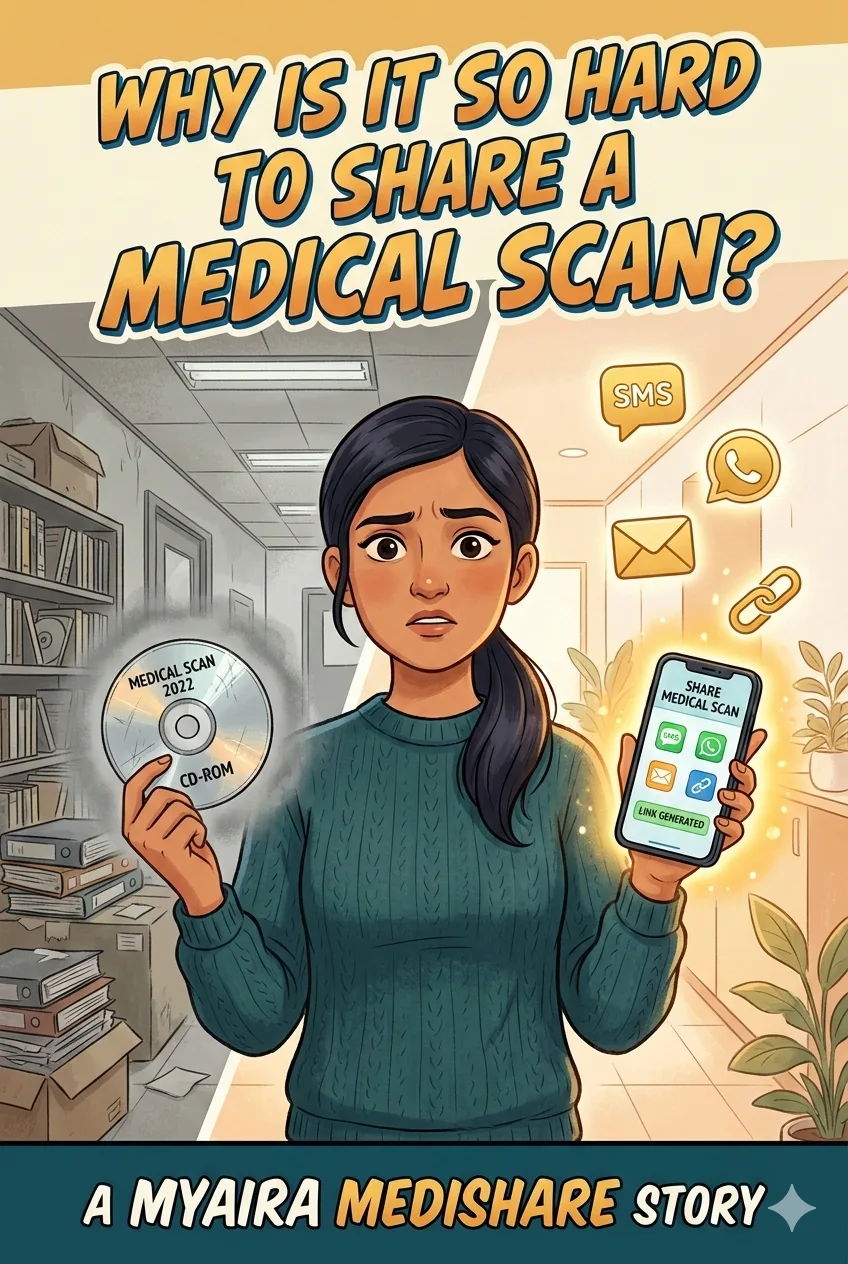
Why Is It So Hard to Share a Medical Scan in 2026?
You just had a CT scan. Your doctor needs to send it to a specialist across town. How long should that take?
If you said “a few seconds,” you’re thinking like someone who lives in 2026. You can send a 4K video to anyone on the planet in under a minute. You can share a bank statement, a signed contract, or a photo of your dog with a single tap.
But your medical scan? That’s a different story.
The absurd reality of medical image sharing
Here’s what actually happens when you need to share a medical scan with another doctor today:
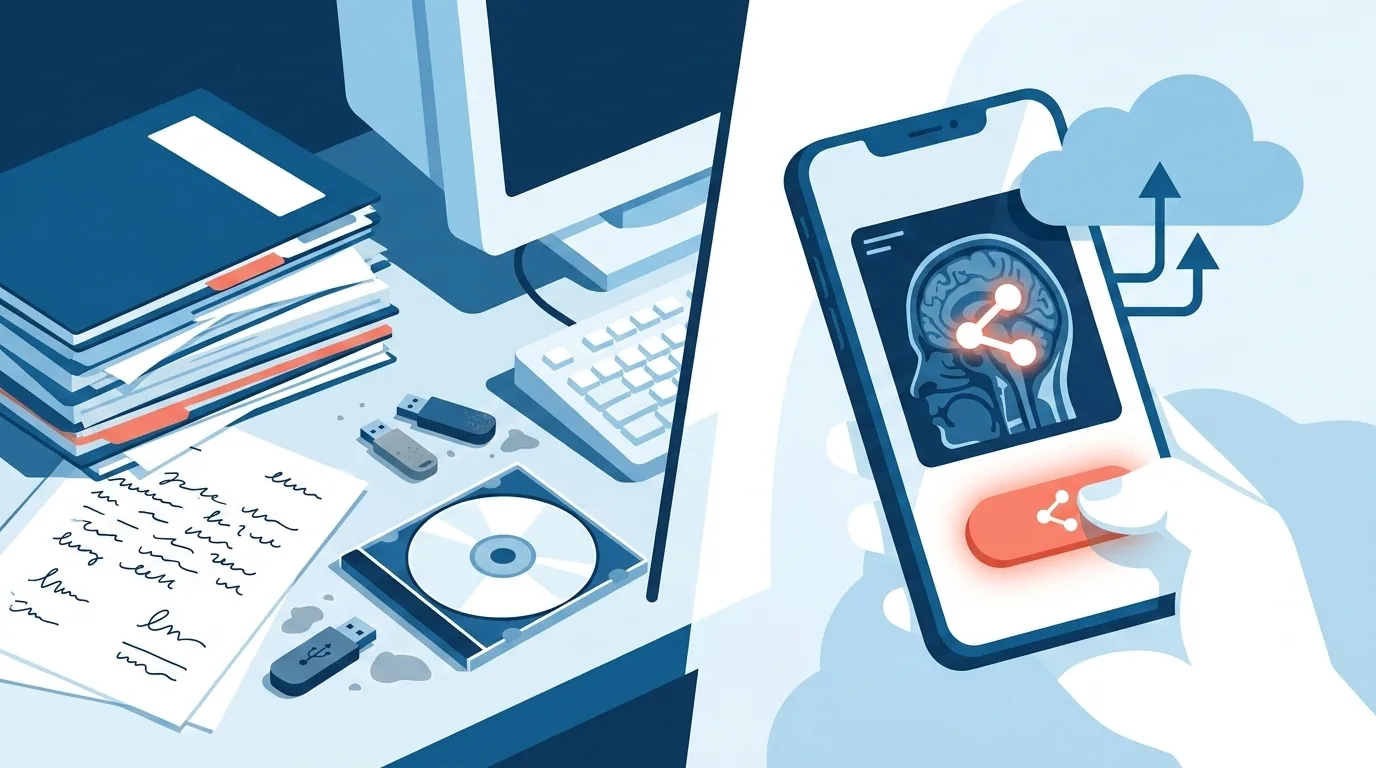
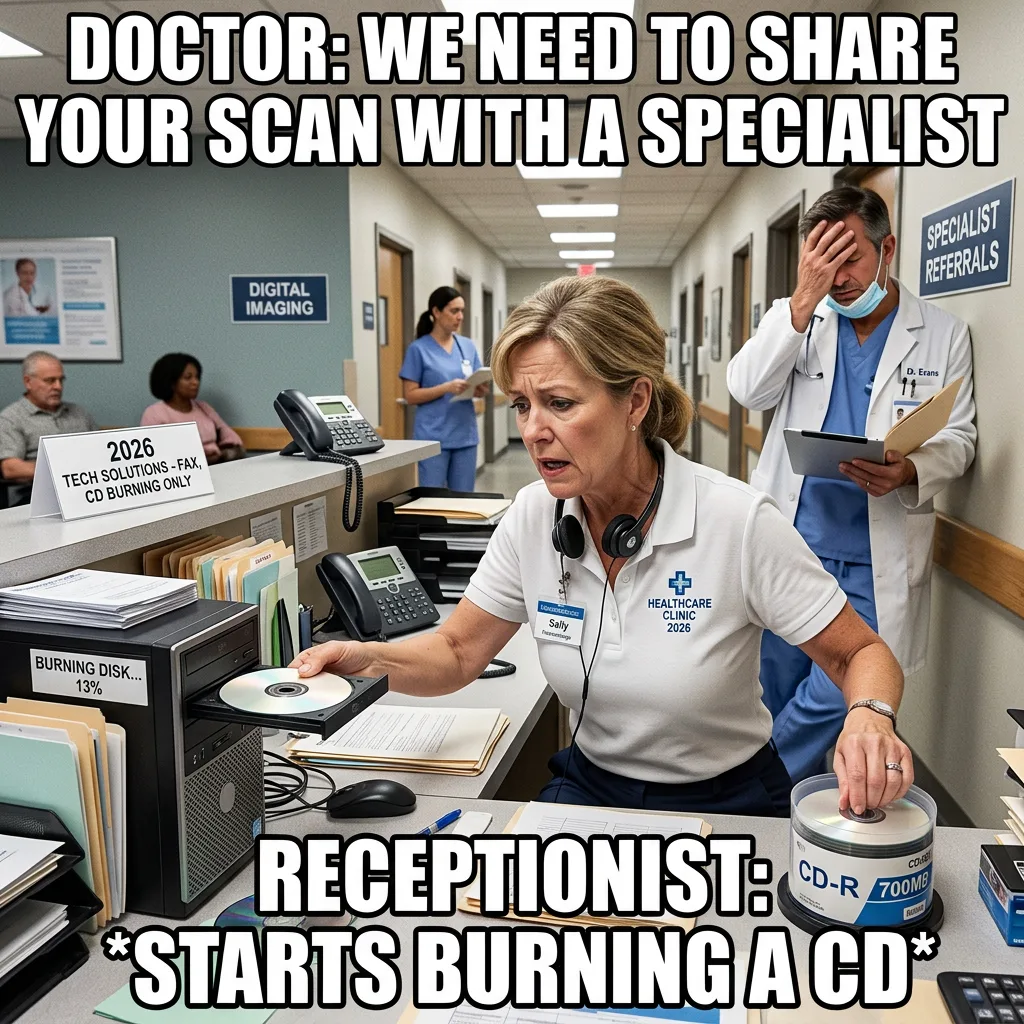
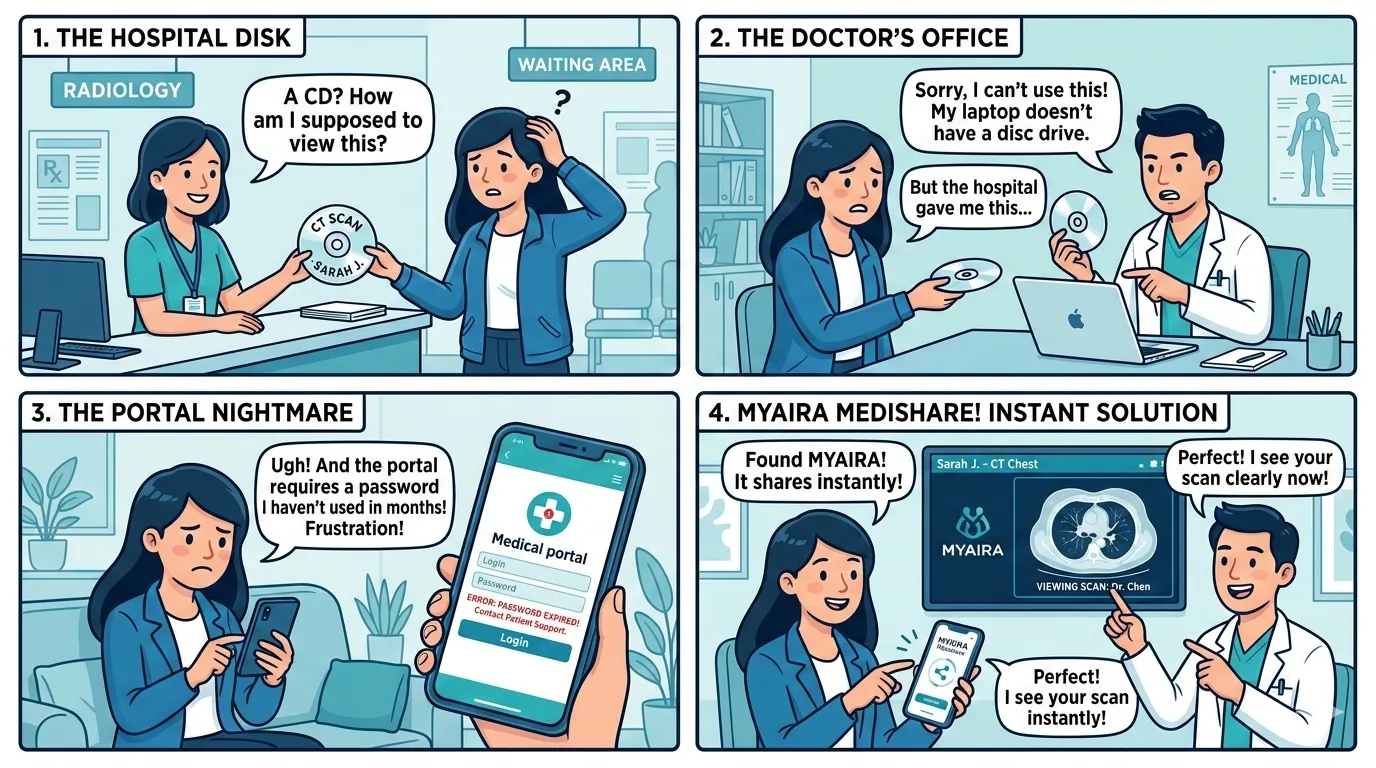
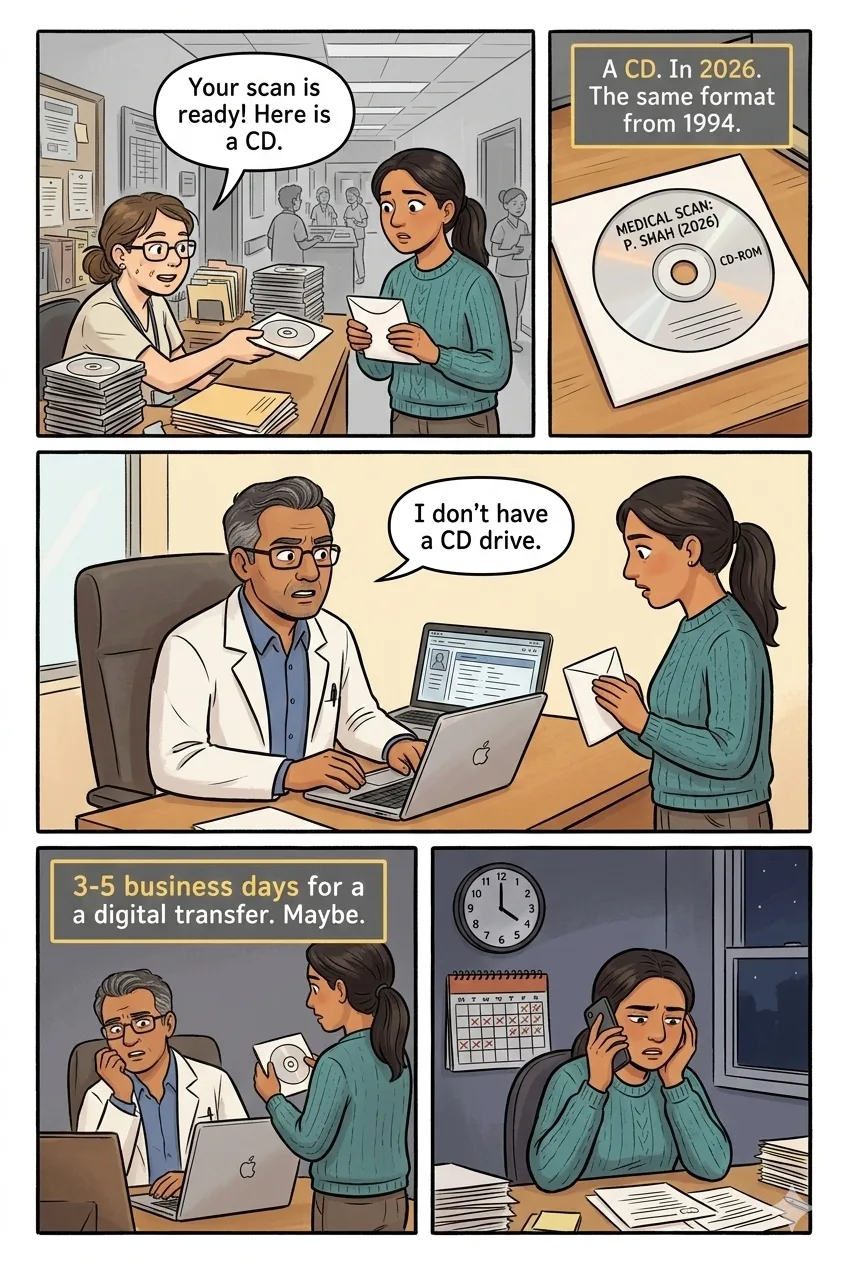
Option 1: The CD. The radiology department burns your images onto a compact disc. Yes, a CD — the same format your parents used to play Nirvana in 1994. You drive to the hospital, wait at a desk, fill out a form, and leave with a plastic disc in a paper sleeve. Then you drive to the other doctor’s office and hand it over. If you’re lucky, their computer has a CD drive. If you’re luckier, the proprietary viewer software on the disc actually runs on their system.
Most of the time, you’re not that lucky.
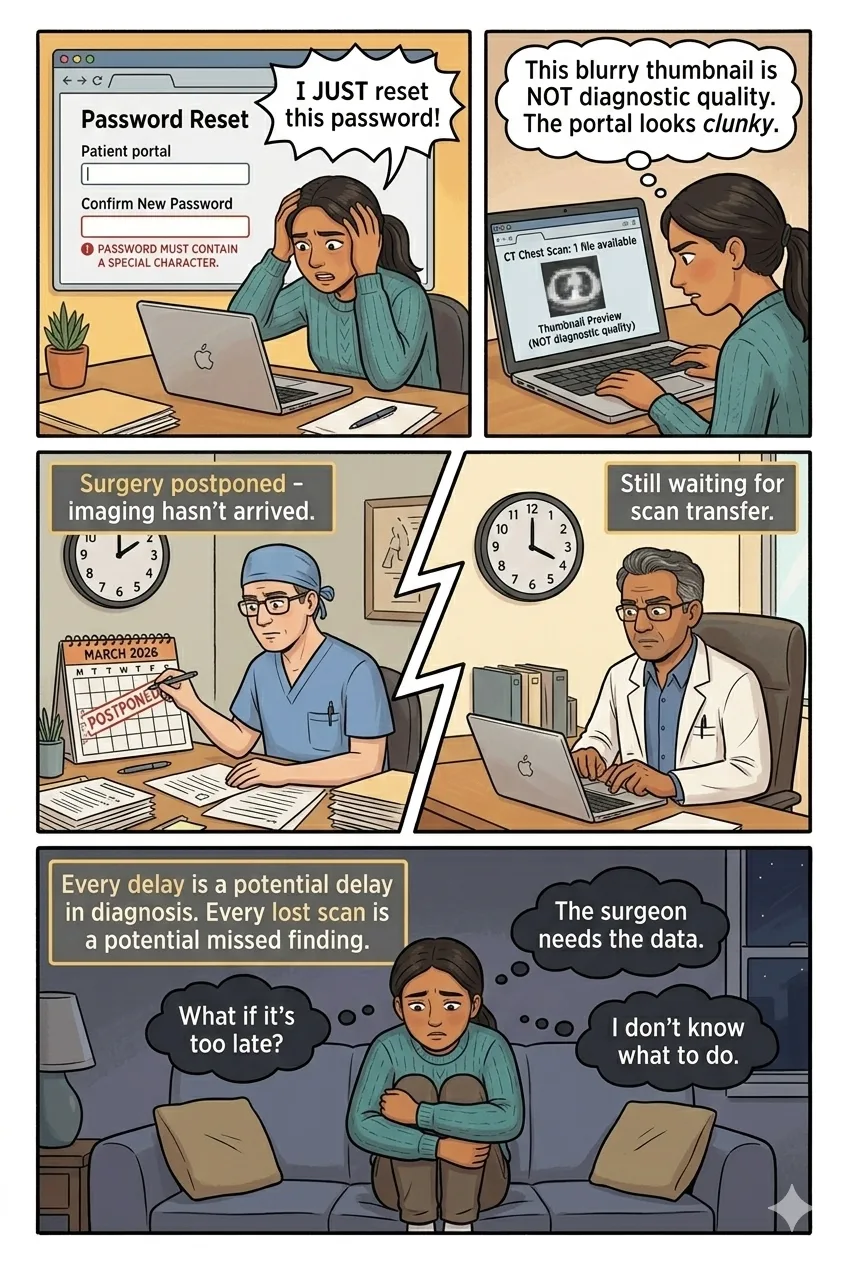
Option 2: The portal. Your hospital has a patient portal. You log in — after resetting your password for the third time — and find a low-resolution thumbnail of your scan. You can’t download the full study. You can’t share it. You can screenshot it and text it to your doctor, but a phone screenshot of a compressed JPEG is not a diagnostic image. Your specialist needs the real thing.
Option 3: The phone call. Your doctor’s office calls the radiology department. They request a transfer. Someone at the other end says they’ll “put it in the system.” Three to five business days later, it may or may not arrive. Nobody is sure. You call back to check. They’re not sure either.
Option 4: The USB drive. Some facilities have moved past CDs — to USB drives. Progress. You still have to physically go pick it up and deliver it.
This isn’t a rare edge case. This is how most medical imaging gets shared in the United States and around the world, right now, in 2026.
“My scan, but I can’t access it”
Let’s talk about what this feels like as a patient.
You went through the scan. You lay still in an MRI tube for 45 minutes, or held your breath while the CT machine whirred around you, or sat in a cold room while a technician pressed an ultrasound wand against your abdomen. The images exist. They’re stored on a server somewhere.
But you can’t see them. You can’t download them. You can’t send them to the doctor you’re seeing next week. You, the person those images are literally pictures of, have less access to your own medical scans than you do to your Netflix watch history.
This isn’t just frustrating. It has real consequences.
A second opinion gets delayed by a week because the scan transfer is “in progress.” A surgeon postpones a procedure because the outside imaging hasn’t arrived yet. A patient moving to a new city starts over with new scans because transferring the old ones is too complicated. A referring physician makes a decision without seeing the images because they can’t wait any longer.
Every delay is a potential delay in diagnosis. Every lost scan is a potential missed finding.
The real cost of doing nothing
The CD-and-portal model isn’t just inconvenient. It’s expensive.
Burning a CD costs a radiology department between $2 and $5 per disc — and that’s just the media and label. Factor in the staff time to burn, package, log, and hand it to the patient, and the true cost per disc reaches $8 to $15. A mid-sized imaging center burning 50 CDs a day spends $100,000 to $200,000 a year on a workflow that patients hate and doctors barely tolerate.
For patients, the cost is time. A trip to pick up a CD. A trip to deliver it. A follow-up call to check if the transfer went through. Hours spent navigating a system that was designed for hospitals, not for the people inside them.
For doctors, the cost is friction. Receiving scans on CDs that won’t open. Logging into unfamiliar portals. Waiting for faxed authorizations before a digital transfer can even begin. Every minute a physician spends chasing images is a minute not spent treating patients.
And for the healthcare system as a whole, the cost is redundancy. When scans can’t be easily shared, they get repeated. Duplicate imaging in the US alone is estimated to cost billions of dollars each year — and exposes patients to unnecessary radiation.
Why hasn’t this been fixed?
It’s a fair question. We can share anything else instantly. Why not medical scans?
Three reasons:
1. Medical images are not normal files. A chest X-ray isn’t a JPEG. Medical images use a format called DICOM — Digital Imaging and Communications in Medicine. A single CT study can contain hundreds of individual slices and weigh several gigabytes. These files need specialized viewers to display correctly. You can’t just attach them to an email.
2. Healthcare IT moves slowly. Hospitals run on systems built in the 2000s (or earlier). Changing how images are stored, transferred, or shared requires navigating layers of IT approvals, vendor contracts, and compliance reviews. The CD persists not because anyone loves it, but because nobody has the budget or mandate to kill it.
3. Existing solutions are built for institutions, not people. The image sharing platforms that do exist — Ambra Health, Purview, Life Image — are designed for hospital-to-hospital exchange. They require accounts, contracts, and IT integration. They were never built for a patient who just wants to text their X-ray to a new doctor.
The result? A gap. A huge, obvious gap between what’s technically possible and what patients and doctors actually experience.
What sharing a medical scan should look like
Imagine this instead:
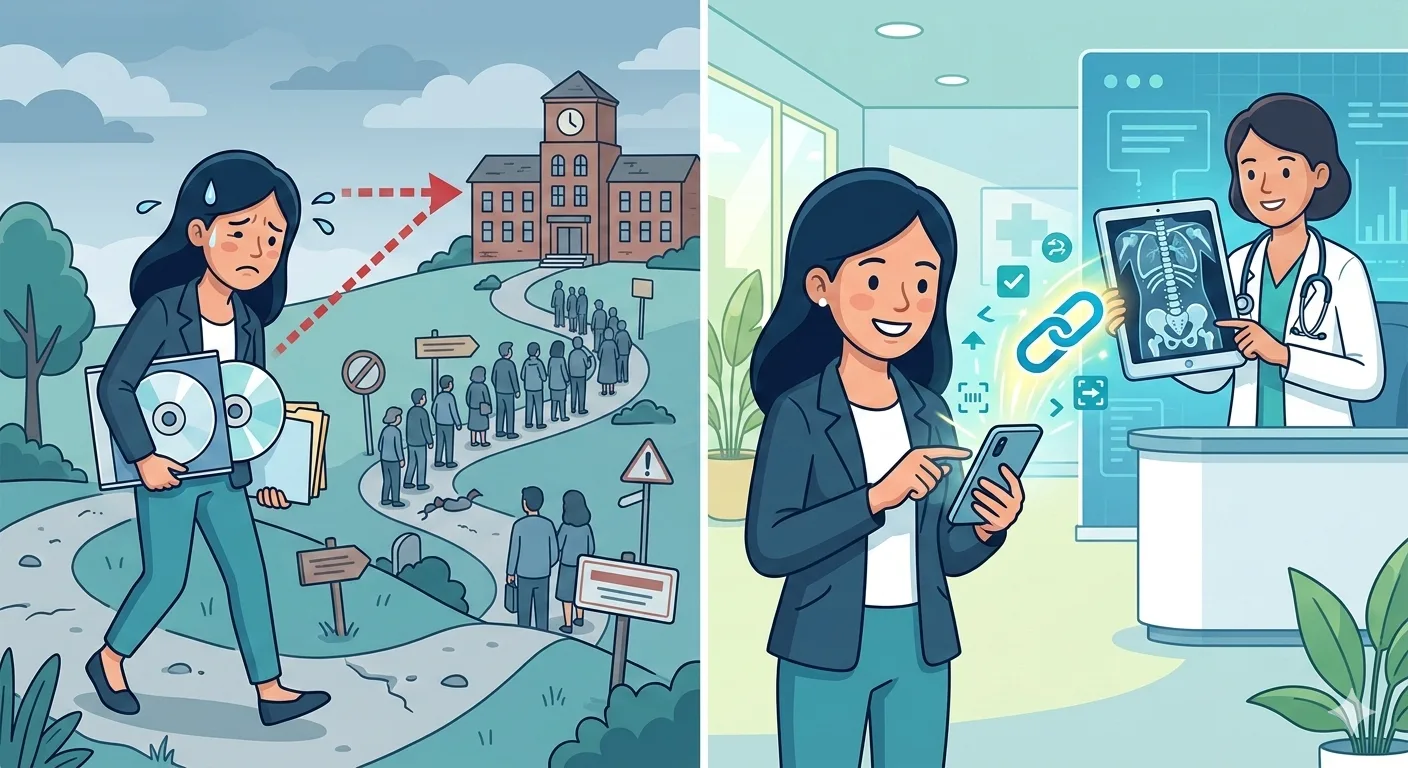
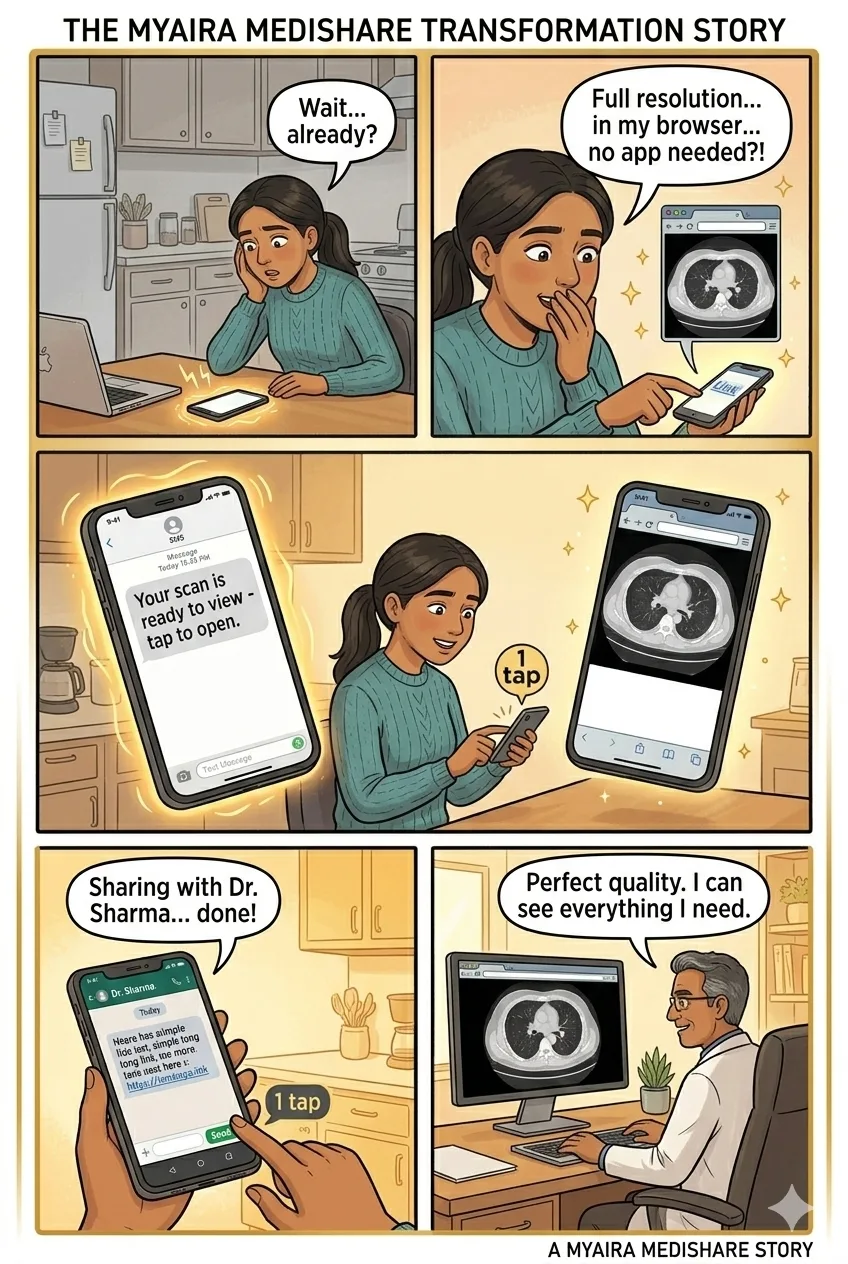
- Your scan is done. Within minutes, you get a link — via SMS, WhatsApp, or email.
- You tap the link. Your scan opens in your phone’s browser. Full resolution. Every slice. No app to download. No account to create.
- You forward the link to your specialist. They open it on their computer. Same full-quality images. They can zoom, scroll, adjust contrast — everything they’d do on their PACS workstation.
Total time: under 30 seconds. Total cost: zero. Total apps downloaded: zero.
That’s not a fantasy. That’s MYAIRA Medixshare, built by AI Bharata.
How MYAIRA Medixshare works
MYAIRA Medixshare is a medical scan sharing platform that does one thing exceptionally well: it gets your scans from point A to point B without the friction.
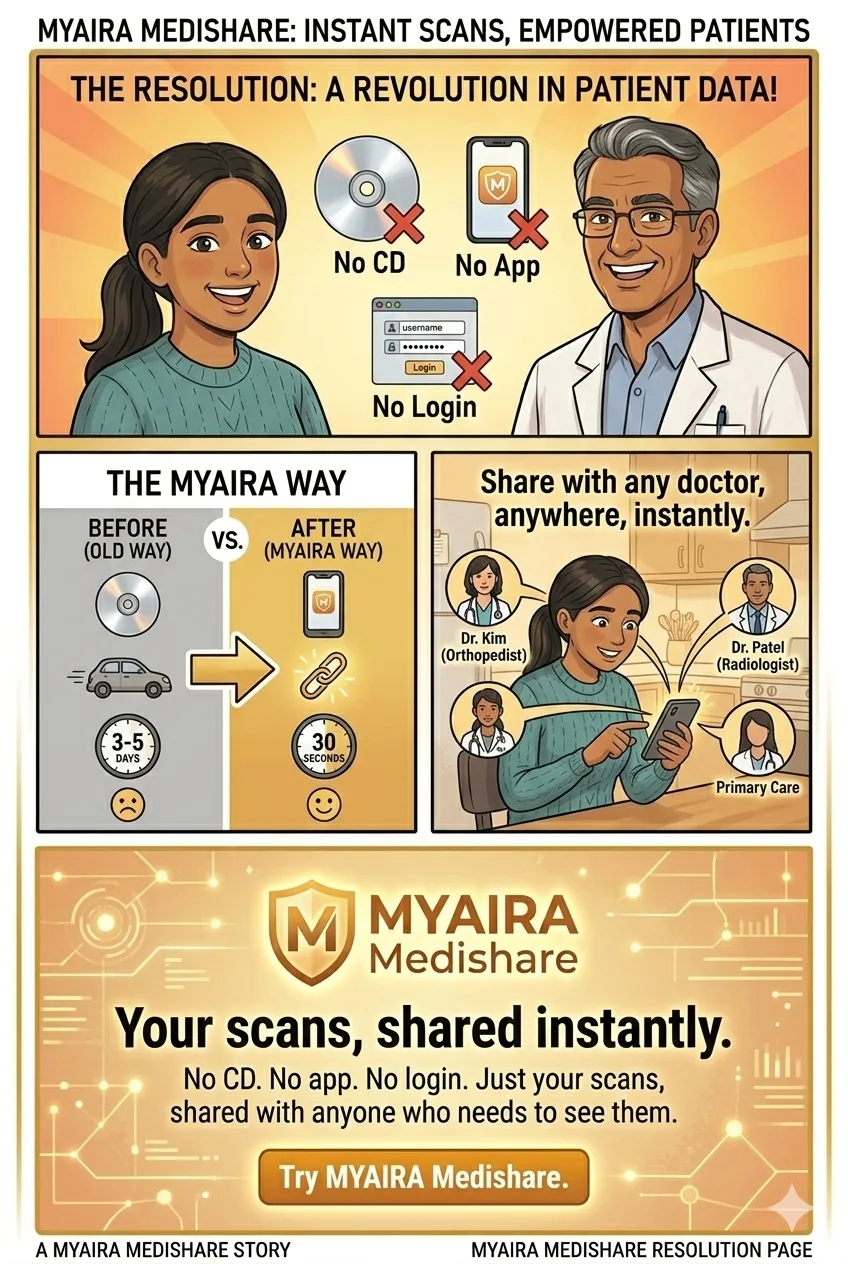
No CD. Your scan is shared digitally, instantly. The CD era is over.
No app. The recipient opens your scan in any web browser — Chrome, Safari, Firefox, on any phone or computer. Nothing to install.
No portal login. No account creation, no password resets, no “your session has expired.” Just a link that works.
No quality loss. Medixshare shares your scan at native, full resolution. Every slice, every pixel, exactly as the radiologist sees it. This isn’t a screenshot or a compressed thumbnail. It’s the real DICOM data, viewable in a diagnostic-quality browser viewer.
Any modality. X-ray, CT, MRI, ultrasound, mammogram, pathology slides — if it’s a medical image, Medixshare can share it.
Patient-controlled. You decide who sees your scans. You can share with one doctor or five. You can revoke access anytime. Your scans, your rules.
It works for patients sharing with doctors. It works for doctors sharing with other doctors. And it works for imaging centers that want to stop burning CDs and start delivering scans the way patients expect in 2026.
What this changes
For patients, Medixshare means you never have to drive to a hospital to pick up a disc again. Your second opinion starts with a text message, not a road trip. Your scans follow you when you move, switch doctors, or travel. You own your medical images in practice, not just in theory.
For referring physicians, it means the outside scans you ordered actually arrive — in seconds, not days. Full quality. Viewable on any device. No CD drives, no proprietary software, no phone calls to the radiology department.
For imaging centers and clinics, it means eliminating one of the most wasteful workflows in your operation. No more CD inventory, no more burning stations, no more staff time spent handing out discs. Your patients get a better experience, and you save real money.
Your scans shouldn’t be this hard to share
We live in an era where a teenager can livestream 4K video to millions of people from a phone. But a patient sharing a single chest X-ray with their own doctor still requires a physical disc and a car ride.
That gap is closing. AI Bharata’s MYAIRA Medixshare makes sharing medical scans as easy as sharing a photo — because it should be.
No CD. No app. No login. Just your scans, shared instantly, with anyone who needs to see them.
Watch: From CD burning to instant sharing — the Medixshare difference
See the Story in Pictures
We turned this article into a comic strip — scroll through to see Priya’s journey from CD frustration to instant scan sharing.
Ready to try it? Share a scan now or learn more about MYAIRA Medixshare.