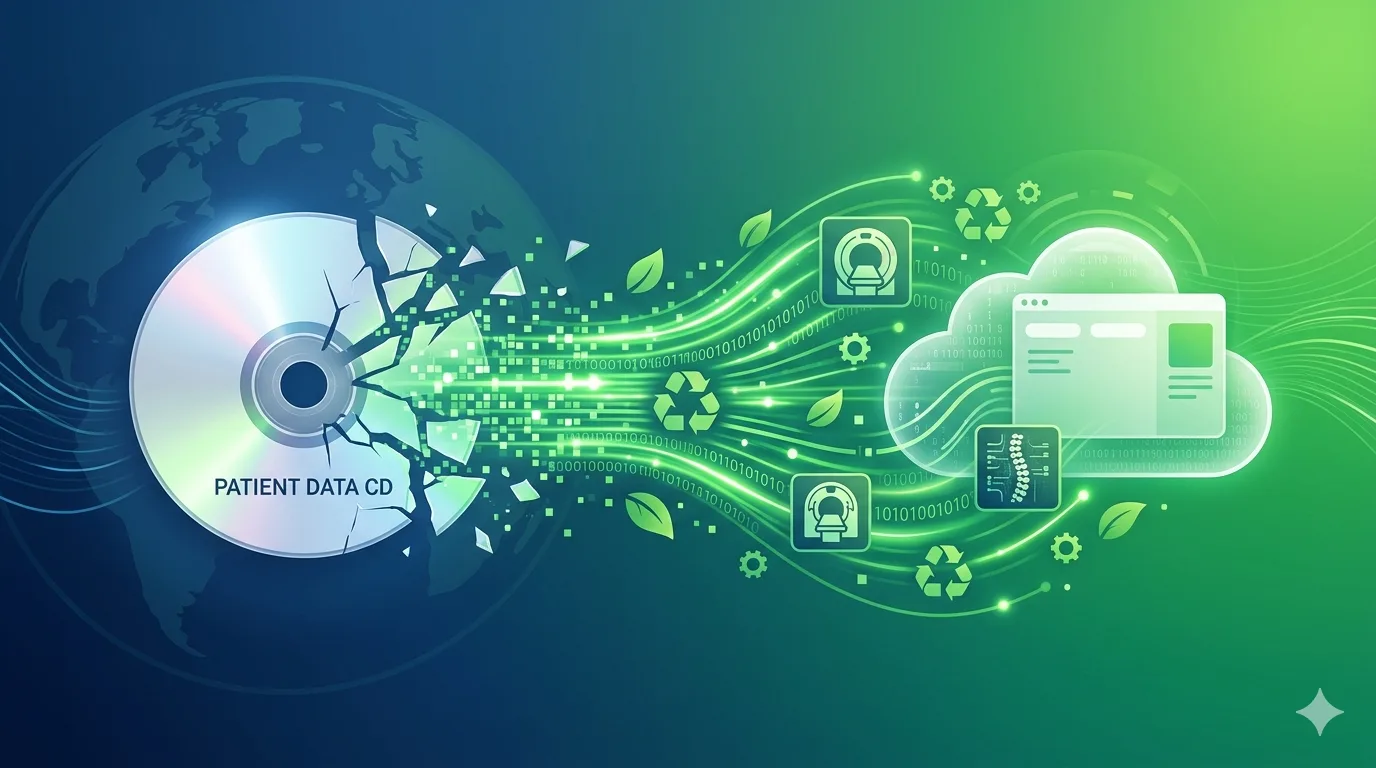
The Green Radiology Movement: How Ditching CDs and Going Digital Cuts Your Carbon Footprint
Healthcare is supposed to heal people. It is not supposed to be one of the largest polluters on the planet.
And yet, the global healthcare sector produces between 4.4% and 5.2% of the world’s greenhouse gas emissions, according to Health Care Without Harm’s landmark climate footprint report. If healthcare were a country, it would be the fifth-largest emitter on Earth — right behind China, the United States, the European Union, and India.
That statistic tends to surprise people. We associate carbon emissions with factories, airlines, and power plants. Not hospitals. But healthcare’s environmental footprint is enormous: energy-intensive facilities running 24/7, complex supply chains spanning continents, single-use plastics measured in tons per day, and — hidden within all of it — a steady stream of polycarbonate discs being burned, couriered, lost, and landfilled.
Medical CDs. The environmental cost nobody talks about.
Healthcare’s carbon problem, by the numbers
Before we get to the CDs, let’s establish the scale of the problem.
The healthcare sector’s environmental impact is well-documented and growing:
- 4.4-5.2% of global greenhouse gas emissions come from healthcare, making it a larger emitter than the aviation or shipping industries
- 8.5% of U.S. greenhouse gas emissions come from the American healthcare system alone — the highest rate of any country
- 6 million tons of waste are generated annually by U.S. hospitals, with patients producing an average of 33.8 pounds of waste per day
- Medical imaging specifically accounts for approximately 1% of total global GHG emissions, according to RSNA — a significant figure for a single healthcare subspecialty
The numbers are directionally clear: healthcare pollutes heavily, and the trend is getting worse. As populations age, imaging volumes increase, and demand for healthcare services rises, the sector’s environmental footprint grows unless systemic changes intervene.
The International Radiology Forum at AOCR 2025 devoted an entire session to “Green Radiology” — a growing movement among radiologists, imaging administrators, and healthcare sustainability officers to reduce the environmental impact of diagnostic imaging. The consensus was unambiguous: radiology departments can and must do more.
One of the simplest, most impactful changes? Eliminating the medical CD.
The hidden environmental cost of medical CDs
Every day, imaging centers across the United States burn hundreds of thousands of medical CDs. Each disc seems trivial — a thin piece of polycarbonate plastic, barely an ounce in weight, costing less than a dollar to produce.
But scale that across the U.S. healthcare system, and the numbers become staggering.
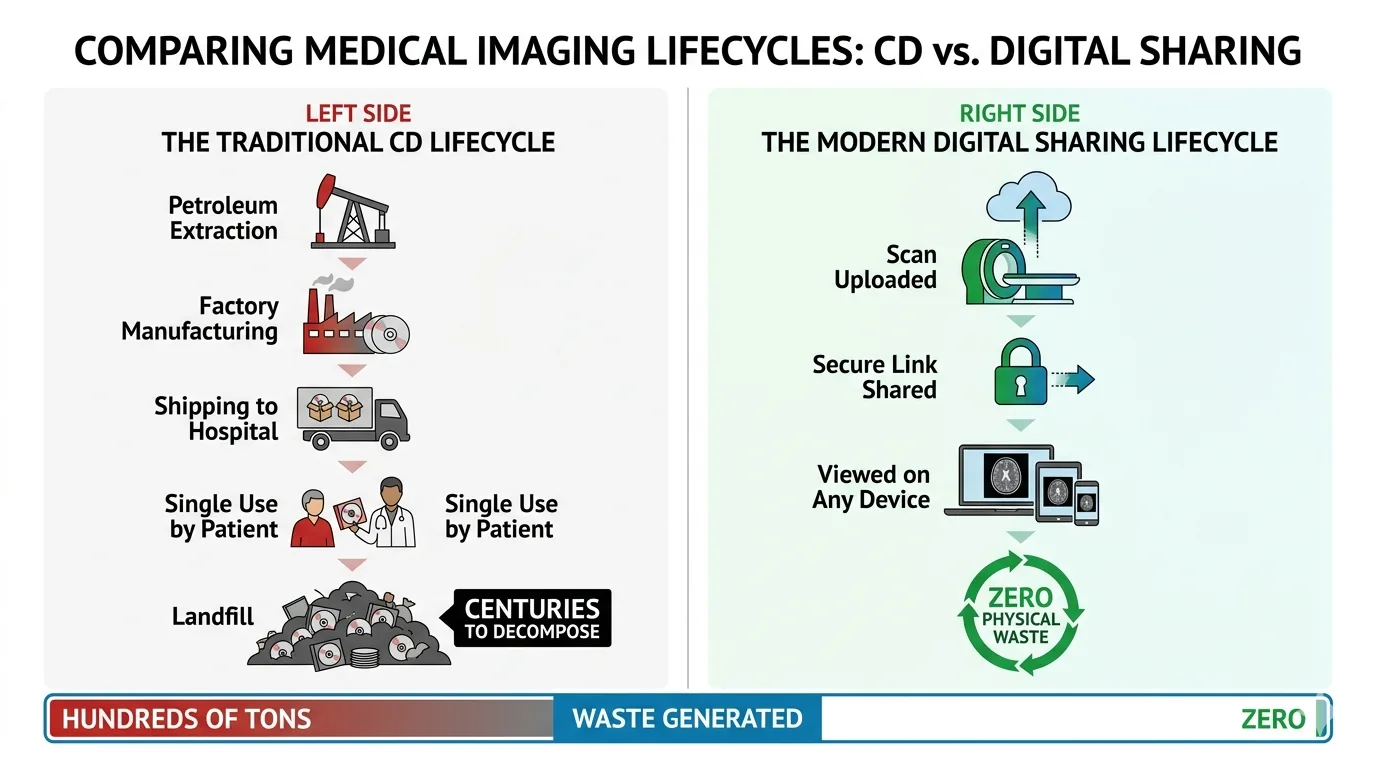
The production footprint. Medical CDs are made from polycarbonate — a petroleum-derived plastic that requires significant energy to manufacture. The production process involves:
- Extracting and refining petroleum feedstocks
- Injection molding polycarbonate into disc form
- Applying reflective aluminum layers and protective coatings
- Manufacturing jewel cases and paper sleeves (additional plastic and paper waste)
- Packaging and shipping to healthcare facilities nationwide
Each step consumes energy and generates emissions. A single CD weighs approximately 16 grams of polycarbonate. Multiply that by tens of millions of discs annually, and you are looking at hundreds of tons of petroleum-derived plastic produced for a single use.
The transport footprint. Medical CDs do not teleport from the imaging center to the specialist’s office. They travel by:
- Patient car trips. The most common scenario: a patient drives to the radiology department, picks up the CD, and drives it to another facility. Two additional car trips that would not exist if the images were shared digitally.
- Courier services. Larger health systems spend significant sums on medical couriers. Yale New Haven Health reported burning approximately 142,000 imaging studies to CDs in a single year, spending nearly $550,000 on disc production alone — before accounting for labor, retrieval, shipping, and courier delivery costs.
- Postal mail. Some facilities mail CDs to patients or referring physicians, adding fuel consumption and packaging waste.
Every one of these transport methods burns fossil fuels and generates carbon emissions that digital sharing eliminates entirely.
The disposal problem — and why it’s worse than regular plastic waste. Here is where medical CDs diverge from ordinary plastic waste in a critical way.
A music CD or software disc can be recycled. Specialized recycling companies grind polycarbonate into raw pellets for reuse in automotive parts, office equipment, and cable insulation.
A medical CD cannot — or at least, should not — be recycled through normal channels. The reason is simple: Protected Health Information (PHI).
Every medical CD contains patient data: names, dates of birth, medical record numbers, clinical notes, and the imaging data itself. Under HIPAA, this information must be destroyed before the disc can leave a patient’s or facility’s control. That means:
- Shredding — specialized disc shredders that physically destroy the media
- Incineration — burning the disc and its data, releasing carbon dioxide and potentially toxic fumes from the polycarbonate and metallic layers
- Landfilling — the most common outcome, where CDs sit intact for centuries because polycarbonate does not biodegrade
Unlike aluminum cans or paper, medical CDs cannot simply be tossed into a recycling bin. The PHI contamination makes them effectively non-recyclable in practice. Most end up in landfills or general waste streams, where they persist indefinitely.
How big is the medical CD waste problem?
Precise industry-wide statistics on medical CD production are hard to find — partly because nobody wants to count them. But the data points we do have paint a clear picture.
More than 630 million diagnostic imaging procedures are performed annually in the United States alone. Globally, the number exceeds 3.6 billion. While not every study results in a CD, a large percentage still do. Industry surveys consistently find that 80% of U.S. healthcare organizations still use physical media as their primary method of sharing medical images.
Let’s do conservative math. If even 20% of the 630 million annual U.S. imaging studies result in a CD being burned — and the real number is almost certainly higher — that is 126 million CDs per year. At 16 grams each:
- 2,016 metric tons of polycarbonate plastic produced annually just for U.S. medical CDs
- Plus jewel cases, paper sleeves, and packaging
- Plus the carbon footprint of manufacturing, transport, and disposal
- Plus the emissions from millions of additional car trips for CD pickup and delivery
And that is just the United States. Globally, the numbers multiply several times over.
For context, 2,000 metric tons of plastic is roughly equivalent to the weight of 400 African elephants — produced every year for a medium that is used once, cannot be recycled, and ends up in a landfill.
The broader radiology waste picture
Medical CDs are just one piece of the environmental puzzle in radiology. The green radiology movement addresses a wider range of sustainability challenges:
Energy consumption. Imaging equipment — particularly MRI and CT scanners — are among the most energy-intensive devices in a hospital. A single academic medical center’s radiology department generated 4,600 metric tons of CO₂ equivalent over a decade, with energy consumption from imaging equipment accounting for more than 50% of departmental emissions. AI-driven protocol optimization has been shown to cut energy consumption by up to 56% and examination time by 55%.
Film and chemical waste. While largely phased out in developed countries, film-based radiography and its associated chemical processing remain common in many parts of the world, contributing to hazardous waste and water contamination.
Data storage. An often-overlooked sustainability factor: data storage accounts for 2% of worldwide electricity consumption and contributes CO₂ emissions comparable to the airline industry. As imaging data volumes grow — a single MRI study can exceed 1 GB — the energy footprint of storing that data in on-premises servers versus efficient cloud infrastructure becomes a meaningful variable.
Contrast agent disposal. MRI and CT contrast agents containing gadolinium and iodine enter wastewater systems through patient excretion, introducing non-biodegradable heavy metals into water supplies.
Within this broader picture, eliminating CDs stands out as one of the highest-impact, lowest-effort sustainability interventions available to a radiology department. Unlike replacing an MRI scanner or redesigning contrast agent chemistry, switching from CDs to digital sharing can happen immediately, with existing technology, at lower cost.
ESG mandates are accelerating the shift
For years, the environmental case for digital image sharing was a “nice to have” — acknowledged but rarely acted upon. That is changing, driven by a convergence of regulatory, accreditation, and investor pressures.
Federal sustainability targets. The U.S. Department of Health and Human Services has asked hospitals to voluntarily reduce emissions by 50% by 2030 and achieve net-zero by 2050. While voluntary today, these targets signal the direction of future regulation.
Joint Commission sustainability standards. In 2024, the Joint Commission International released its 8th Edition of Accreditation Standards for Hospitals, incorporating a Global Health Impact (GHI) chapter that brings healthcare sustainability into the accreditation framework. Hospitals seeking JCI accreditation now face formal expectations around environmental performance.
ESG reporting requirements. Institutional investors and rating agencies increasingly evaluate healthcare organizations on Environmental, Social, and Governance criteria. Organizations with strong ESG strategies tend to outperform those without. Eliminating wasteful physical media from imaging workflows is a measurable, reportable ESG win.
The green radiology certification movement. In 2024, the Brazilian College of Radiology (CBR) introduced its Socio-Environmental Seal — a tiered certification program (Bronze, Silver, Gold) that guides imaging centers in adopting environmental sustainability best practices. RSNA has established a formal Environmental Sustainability in Imaging initiative. Multiple national radiology societies have published joint position papers calling for systemic sustainability action.
The regulatory trajectory. As we covered in our analysis of ONC’s imaging interoperability RFI, federal regulators are actively building the framework to eliminate physical media from medical image exchange. The environmental benefit is a powerful secondary argument reinforcing the operational and patient-experience case for going digital.
For hospital administrators and sustainability officers, the message is converging from every direction: physical media for medical imaging is an operational liability, a patient experience problem, a security risk, and now an environmental liability on your ESG scorecard.
The digital alternative: what the math looks like
Switching from CDs to digital image sharing does not just eliminate waste. It fundamentally changes the environmental equation.
Zero physical waste. Digital sharing produces no polycarbonate discs, no jewel cases, no packaging, and no courier packaging. The imaging data that already exists in digital form stays in digital form.
Eliminated transport emissions. No patient car trips to pick up CDs. No courier runs. No postal shipments. A scan shared digitally travels at the speed of light, not the speed of a delivery van.
Reduced energy per share. While digital infrastructure consumes energy, cloud-based sharing is dramatically more efficient per transaction than the production-transport-disposal chain of a physical CD. Modern cloud data centers operate at Power Usage Effectiveness (PUE) ratios approaching 1.1, meaning nearly all electricity goes to useful computation rather than cooling and overhead.
Scalable efficiency. The marginal environmental cost of sharing one additional scan digitally approaches zero. The marginal cost of one additional CD is fixed: raw materials, manufacturing energy, transport fuel, and landfill space.
Let’s compare the two approaches for a mid-sized imaging center performing 50,000 studies per year:
| Factor | CD-based sharing | Digital sharing |
|---|---|---|
| Annual discs produced | ~40,000 | 0 |
| Polycarbonate waste | ~640 kg | 0 |
| Annual courier/mail shipments | Thousands | 0 |
| Patient car trips for pickup | Tens of thousands | 0 |
| PHI disposal cost | Shredding/incineration | N/A |
| Time to share | Hours to days | Seconds |
The environmental savings compound across every imaging center that makes the switch. At national scale, the reduction in plastic waste, transport emissions, and landfill burden is substantial.
What green radiology looks like in practice
Hospitals and imaging centers leading the green radiology movement are not waiting for mandates. They are acting now, and digital image sharing is consistently among the first interventions they adopt.
Step 1: Eliminate CDs from standard workflows. Set digital sharing as the default. Offer CDs only when specifically requested and when no digital alternative is available. Most patients prefer digital access — they just need to be offered the option. As we discussed in 5 Questions to Ask Before Your Scan Gets Burned to a CD, patients have the legal right to access their imaging data electronically.
Step 2: Implement cloud-based sharing. Replace the CD burner with a sharing link. Medixshare, built by AI Bharata, enables this transition immediately: upload a study, generate a secure link, share via SMS, WhatsApp, or email. The recipient views diagnostic-quality images in any browser, on any device. No disc, no drive, no software installation.
Step 3: Quantify and report environmental impact. Track the number of CDs eliminated, the transport trips avoided, and the waste diverted from landfill. Include these metrics in your sustainability reporting and ESG disclosures. What gets measured gets managed.
Step 4: Extend to the full imaging workflow. Green radiology goes beyond CDs. Optimize imaging protocols to reduce unnecessary scans (the greenest scan is the one that was never needed). Implement AI-assisted triage to reduce energy-intensive repeat studies. Use MYAIRA’s AI analysis to get faster, more confident reads that reduce the diagnostic cycle time and the associated resource consumption.
Step 5: Engage patients. Patients increasingly make healthcare decisions based on values, including environmental values. Communicating your commitment to sustainable imaging practices differentiates your facility and resonates with the growing segment of environmentally conscious healthcare consumers.
The patient perspective
For patients, the environmental case for digital sharing adds another dimension to an already compelling argument.
We have written extensively about why sharing medical scans on CDs is slow, frustrating, and increasingly obsolete. We have covered the security risks of physical media that can be lost or stolen. We have covered the regulatory trajectory that is pushing the industry toward digital exchange.
Now add the environmental dimension: every CD a patient accepts is a piece of non-recyclable plastic that will sit in a landfill for centuries. Every pickup trip burns fuel for a task that technology solved years ago. Every courier run adds emissions for a journey that electrons could make instantaneously.
Patients who care about their environmental footprint — and surveys consistently show that number is growing, particularly among younger demographics — now have one more reason to ask their imaging center: “Can I get my scan digitally instead?”
The answer should always be yes.
The economics align with the environment
One of the most important dynamics in sustainability is when the environmentally responsible choice is also the economically rational one. Medical CD elimination is a textbook case.
Consider what a health system spends annually on CDs:
- Media cost: $1-4 per disc
- Burning equipment: Maintenance and replacement of CD/DVD burners
- Staff time: Burning, labeling, packaging, and distributing discs
- Courier costs: Some systems spend $100,000+ per year on medical courier services
- PHI disposal: Secure shredding or incineration of returned or unclaimed discs
- Re-burns: CDs that are lost, damaged, or unreadable must be re-created
Yale New Haven Health’s reported $550,000 annual expenditure on CD production — before labor and courier costs — is not unusual for a large health system. Mid-sized imaging centers routinely spend $50,000-$100,000 per year on physical media workflows.
Digital sharing eliminates virtually all of these costs. The economic savings fund the environmental benefit. There is no tradeoff — just a better way to operate.
The movement is here. The tools exist. The time is now.
The green radiology movement is not a future aspiration. It is a present reality, endorsed by the world’s leading radiology organizations:
- RSNA has established a formal Environmental Sustainability in Imaging program
- ACR, ESR, RANZCR, and eight other national societies published a joint position paper calling for systemic sustainability action in radiology
- CBR launched a tiered environmental certification for imaging centers
- International Radiology Forum 2025 dedicated proceedings to green radiology and sustainability
The technology to act is equally mature. Digital image sharing platforms like Medixshare are production-ready, HIPAA-compliant, and cost less than the CDs they replace. AI-assisted analysis reduces unnecessary repeat imaging and accelerates diagnostic workflows. Cloud infrastructure eliminates the energy overhead of on-premises storage.
The environmental, operational, economic, and patient experience arguments have converged. The medical CD is the floppy disc of healthcare — a legacy format that persists only through institutional inertia, not because it serves anyone’s interests.
Every disc you don’t burn is polycarbonate that doesn’t go to a landfill. Every trip you eliminate is fuel that isn’t burned. Every courier you replace with a digital link is emissions that don’t enter the atmosphere.
Green radiology starts with one simple change: share the scan, not the disc.
Ready to eliminate CDs from your imaging workflow? Get started with Medixshare — share medical scans instantly via secure link. No disc, no courier, no landfill. Better for patients, better for operations, better for the planet.
Want AI-assisted analysis that reduces unnecessary repeat imaging? Explore MYAIRA AI — fast, accurate, and designed to help radiologists work smarter, not harder.