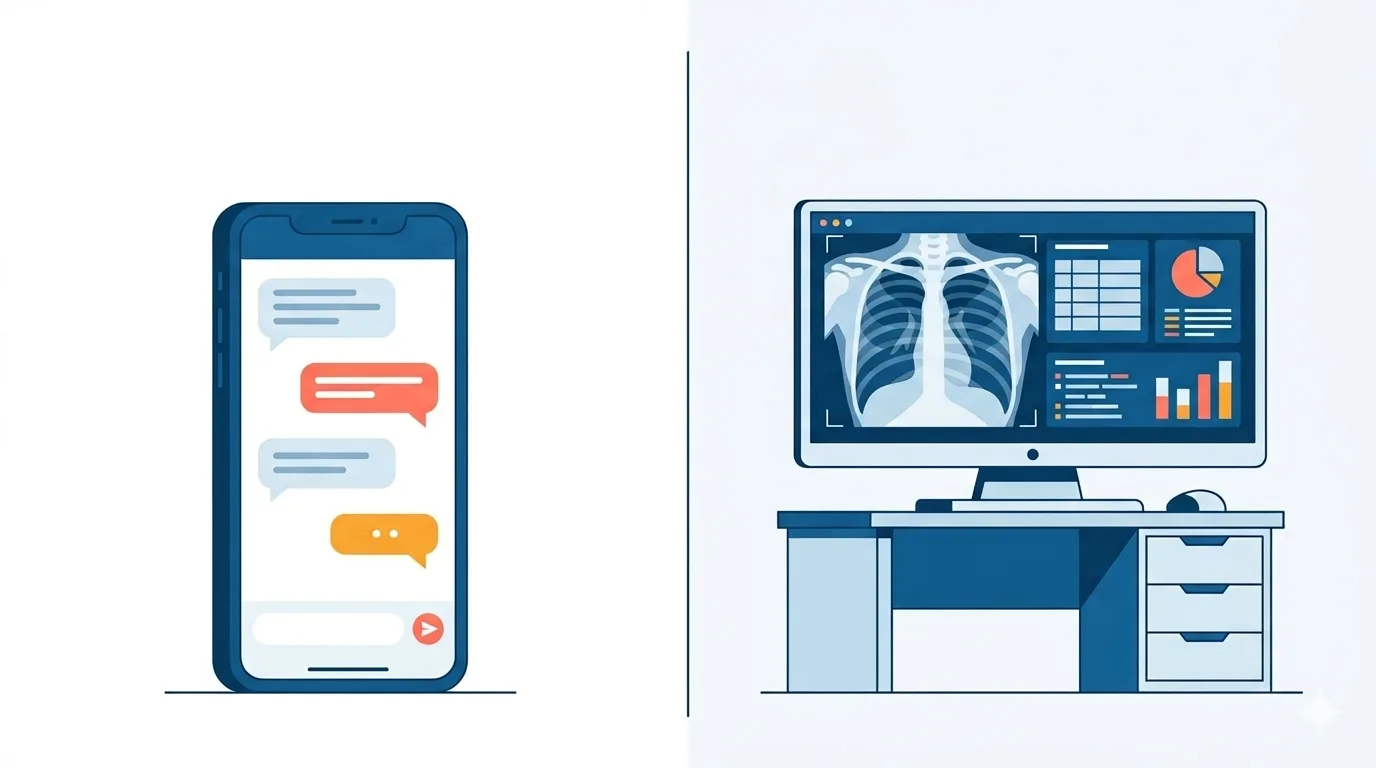
ChatGPT Health vs. Clinical-Grade AI: Why Patients Should Not Upload X-Rays to a Chatbot
You got your chest X-ray results back. The radiologist’s report mentions something you do not fully understand — “bibasilar atelectasis” or “mild cardiomegaly” or “patchy opacity in the right middle lobe.” You are worried, your follow-up appointment is a week away, and ChatGPT is right there on your phone. So you take a photo of the X-ray displayed on the patient portal, upload it to ChatGPT Health, and ask: “What does this show? Should I be concerned?”
Millions of patients are doing exactly this. And it is a problem.
Not because asking questions about your health is wrong — it is not, and in fact patients should be empowered to understand their own medical data. The problem is that the tool they are reaching for was not built for this purpose, is not regulated for it, and can produce answers that are confidently wrong in ways that change clinical decisions.
This is not an argument against AI in medicine. It is an argument for the right kind of AI in medicine. There is a meaningful difference between a consumer chatbot that happens to accept image uploads and a clinical-grade AI system purpose-built for medical image analysis. That difference matters for your privacy, your accuracy, and ultimately your care.
What ChatGPT Health Actually Is
In January 2026, OpenAI launched ChatGPT Health — a set of health-focused features within ChatGPT that allow users to upload lab results, medication lists, and medical images for AI-assisted interpretation. The feature was marketed as making health information more accessible to consumers, and by any measure, it succeeded at adoption. Within months, millions of users were uploading health data.
ChatGPT Health is impressive technology applied to the wrong problem. Here is why.
It is a general-purpose language model. ChatGPT was trained to generate fluent, plausible text across every topic. It was not trained specifically to detect pathologies in medical images. When you upload a chest X-ray, ChatGPT applies general visual understanding and medical knowledge from its training data to produce a response. It does not run the image through a dedicated pathology detection pipeline trained on hundreds of thousands of labeled radiographs with radiologist-verified ground truth.
It does not use standardized medical imaging formats. Clinical AI systems analyze DICOM files — the native format of medical imaging that preserves full resolution, calibration data, and metadata. When you take a photo of your X-ray on a screen and upload it to ChatGPT, you are sending a compressed JPEG or PNG that has lost resolution, introduced screen glare, and stripped all diagnostic metadata. The AI is analyzing a photograph of a medical image, not the medical image itself.
It is not FDA-cleared for medical image analysis. The FDA classifies AI systems that analyze medical images as medical devices, subject to rigorous clinical validation before they can be marketed for diagnostic use. ChatGPT Health carries no such clearance. OpenAI’s terms of service explicitly state that ChatGPT is not a medical device and should not be used for medical diagnosis. Yet the product design — “upload your lab results and images” — implicitly invites exactly that behavior.
The Hallucination Problem
Every large language model hallucinates. This is not a bug that will be fixed in the next version. It is a fundamental characteristic of how these models work — they generate statistically probable text, and sometimes probable text is wrong.
In most contexts, hallucination is an inconvenience. ChatGPT invents a citation that does not exist? Annoying but harmless. ChatGPT confidently identifies a “suspicious opacity in the left upper lobe” on a chest X-ray that is actually normal? That is a different category of harm entirely.
Multiple studies have examined the accuracy of general-purpose AI chatbots on medical imaging interpretation tasks:
- A 2024 study in Radiology found that GPT-4V correctly identified the primary finding on chest X-rays only 55-65% of the time, compared to 85-95% for dedicated chest X-ray AI systems. More concerning, the model produced fabricated findings — hallucinated abnormalities on normal films — in approximately 15-20% of cases.
- Consumer AI chatbots demonstrated high variability in response quality. The same image uploaded twice could produce different assessments depending on how the question was phrased.
- When errors occurred, they were presented with the same confident, well-structured language as correct answers. There was no reliable signal to help a patient distinguish an accurate assessment from a hallucination.
For a patient who is already anxious about a finding on their X-ray, a confidently stated hallucination from an AI chatbot can trigger unnecessary emergency visits, medication changes, or panic — or, in the opposite direction, false reassurance about a finding that actually warrants urgent follow-up.
The Privacy Problem
When you upload a medical image to ChatGPT, you are sending protected health information to a consumer technology platform. This raises concerns that most patients do not consider in the moment.
ChatGPT is not HIPAA-compliant for individual consumer use. OpenAI offers a HIPAA-compliant API for healthcare organizations that sign a Business Associate Agreement. But the consumer ChatGPT product — the one patients actually use — does not operate under a BAA. Your uploaded medical images are processed by OpenAI’s infrastructure without the privacy protections that apply to medical data handled by healthcare providers.
Data retention and training. By default, conversations with ChatGPT may be used to improve the model. While OpenAI has added controls for users to opt out of training data use, the default behavior and the mechanics of data handling are not equivalent to the encryption, access controls, and audit trails that HIPAA-compliant medical data handling requires.
No access controls. When you share a medical image through a clinical system, access is controlled, logged, and revocable. When you upload an image to a consumer chatbot, you have no control over who at the platform can access it, how long it is stored, or whether it is used for purposes beyond your request.
This is not about abstract privacy principles. Medical images contain your name, date of birth, and detailed visual information about the inside of your body. They deserve the same protection as any other sensitive medical record.
What Clinical-Grade AI Actually Looks Like
The comparison between ChatGPT medical images analysis and purpose-built clinical AI is not a matter of degree. It is a difference in kind. Here is what AI-assisted diagnosis actually means when the system is built for clinical use:
Purpose-built models. Clinical chest X-ray AI systems are trained specifically on medical imaging data — hundreds of thousands of DICOM studies labeled by board-certified radiologists. The models learn to detect specific pathologies at specific locations with quantified confidence. They are not guessing based on general knowledge. They are pattern matching against a curated, validated training set.
Standardized input. Clinical AI analyzes native DICOM images at full resolution with all diagnostic metadata intact. No phone photos, no screen glare, no JPEG compression. The analysis operates on the same data quality that a radiologist would read.
Quantified, validated accuracy. Clinical AI systems publish sensitivity and specificity metrics per pathology, validated on independent datasets. A system that reports 94% sensitivity for pneumothorax detection has been tested against ground truth confirmed by expert radiologists. ChatGPT publishes no equivalent metrics for medical image analysis because it is not designed or validated for that purpose.
Structured output. Clinical AI returns structured findings: detected pathologies, confidence scores, and heatmap overlays showing exactly where in the image the finding was identified. This structured output integrates into clinical workflows and enables informed physician review. ChatGPT returns free-text prose that may or may not accurately reflect what is in the image.
Regulatory oversight. Clinical AI for medical imaging is subject to FDA 510(k) clearance (US), CE marking (EU), and the new EU AI Act requirements for high-risk AI systems. These regulatory frameworks require clinical validation, adverse event reporting, and ongoing performance monitoring. Consumer chatbots face none of these requirements.
HIPAA compliance by design. Clinical platforms handle medical images with encryption, access controls, audit trails, and compliance frameworks built into the architecture from the ground up — not added as an afterthought for enterprise customers.
What Patients Should Do Instead
If you have a medical image and want to understand it better, here is the practical guidance:
1. Ask your doctor. This is the answer that matters most. Your radiologist or referring physician has the clinical context — your symptoms, history, prior imaging — that no AI system, consumer or clinical, can replicate. If the report is confusing, call the office and ask for a plain-language explanation.
2. Share your scan securely with a specialist. If you want a second opinion, share your scan properly. Medixshare lets you share your native-resolution medical images with any doctor via a secure link — sent by SMS, WhatsApp, or email. No app download required, no CD, no portal login. The receiving physician sees the full DICOM image, not a phone photo, and can make a proper clinical assessment. This is how medical images were meant to be shared: securely, at full quality, with you in control.
3. Use clinical-grade AI if you want AI analysis. If you want AI to analyze your scan, use a system built for that purpose. MYAIRA AI analyzes chest X-rays for over fifteen pathologies in under three seconds, with confidence scores and heatmap overlays — using the native DICOM image, not a photograph. The free tier includes 50 analyses per month, no credit card required. It is not a chatbot giving you a paragraph of prose. It is a clinical decision support tool giving you structured, validated findings that you and your doctor can review together.
4. Do not make clinical decisions based on chatbot output. If ChatGPT tells you your X-ray looks normal, do not cancel your follow-up appointment. If it tells you something looks concerning, do not go to the emergency room based solely on that output. Consumer chatbot analysis of medical images is not a substitute for clinical care, and treating it as one can lead to real harm.
The Bigger Picture
The instinct to seek answers about your health is entirely reasonable. Patients should have access to their medical data and the tools to understand it. The problem is not that patients want AI help — it is that the most visible, most accessible AI tool was not built for this purpose.
Clinical-grade AI in radiology is real, available, and increasingly accessible. Systems like AI Bharata’s MYAIRA AI provide the accuracy, privacy, and structured output that medical image analysis requires. And when you need a specialist’s eyes on your scan, secure sharing platforms like AI Bharata’s Medixshare give you a path to a proper second opinion without compromising your privacy or image quality.
The gap between consumer AI and clinical AI is not closing. It is widening, as clinical systems benefit from regulatory validation, specialized training, and integration with real clinical workflows. Patients deserve to know that gap exists — and to know that better options are already available.
Your X-ray deserves better than a chatbot. So do you.
Want a proper AI analysis of your scan? Try MYAIRA AI free — 50 analyses per month, clinical-grade accuracy, HIPAA-compliant. Or share your scan securely with any specialist using Medixshare — no app, no CD, no portal login. See all features.